
Video Testimonial Questions: A Practical Interview Guide
Run testimonial interviews that produce useful evidence instead of rehearsed praise. Ask about context, specific changes, metric definitions, and unresolved limits.
A useful video testimonial interview is not a search for compliments. It is a structured way to help a customer describe what happened in their own words: the situation before the purchase, the decision context, what changed, what did not change, and which claims they can actually support. The interviewer's job is to create space for specific evidence without scripting the conclusion.
That distinction matters because a polished video can make weak evidence feel stronger than it is. A customer should not be pressured to endorse a statement they cannot support. If the interview includes compensation, free product, or another material connection, the marketing use may require disclosure. Consent should cover recording and publication, and the evidence file should preserve the unedited source so later edits can be checked against what the customer actually said.
| Interview stage | Useful question type | What to avoid |
|---|---|---|
| Context | Role, situation, problem, decision criteria | Leading the customer toward a praise statement |
| Before | What was happening before the change? | Assuming the problem was severe or universal |
| Process | What did implementation or use involve? | Skipping constraints and effort |
| Change | What specifically changed, and how was it observed? | Supplying the result in the question |
| Limits | What tradeoffs or unresolved issues remain? | Editing out every qualification |
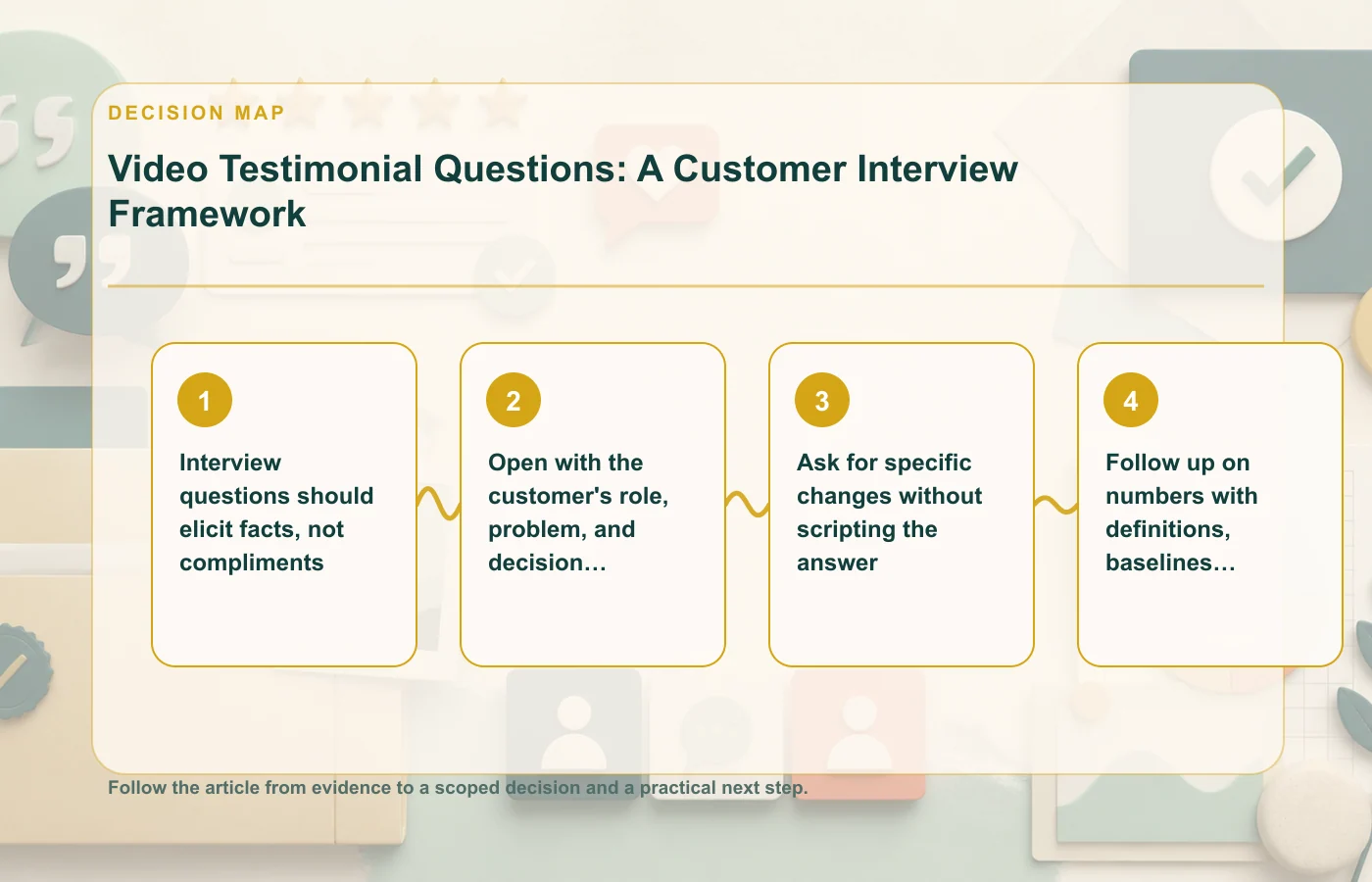
Interview questions should elicit facts, not compliments
"Did you love the product?" is easy to answer but produces little usable evidence. Better questions ask the customer to reconstruct the experience. What problem were they trying to solve? What alternatives or constraints mattered? What happened after they started using the product or service? Those questions invite detail without dictating the conclusion.
Start with open, factual prompts
- What was happening before you looked for a solution?
- What made this problem worth addressing?
- What did you need the solution to do?
- What changed after you started using it?
- What would you tell someone with a similar situation to check before deciding?
The wording should leave room for a neutral or mixed answer. If the customer says a change was smaller than expected, that is part of the evidence. Do not immediately reframe the response into a stronger benefit. Follow up for clarity, not for enthusiasm.
Review the interview outline before recording and flag any question that contains the answer you hope to hear. A good test is to ask whether the customer could reasonably disagree with the premise of the question. If not, rewrite it.
Open with the customer's role, problem, and decision context
Testimonials become more useful when the audience can understand who is speaking and why the experience is relevant. That does not require exposing unnecessary personal information. It means giving enough context to interpret the story: the customer's role or situation, the problem they were addressing, and the conditions that shaped the decision.
Establish relevance before results
A result without context is difficult to evaluate. Ask what the customer was responsible for, what the existing process looked like, and what constraints mattered. In a B2B interview, implementation conditions or stakeholders may be relevant. In a consumer setting, the useful context may be the intended use and the problem the person wanted to solve.
If a material connection exists because of compensation, free product, or another relationship, keep that disclosure question separate from the storytelling prompts. The customer should not be expected to remember legal or campaign wording while answering. The publishing team should preserve the relationship record and ensure that required disclosure remains attached to the final use.
For adjacent review-collection workflows, see how to request customer reviews without manipulating feedback. Review collection and testimonial interviews are different formats, but both depend on neutral prompting.
Ask for specific changes without scripting the answer
Specificity is valuable, but it should come from follow-up questions rather than supplied claims. If a customer says "things got easier," ask what became easier. If they say "we saved time," ask what task changed and how they know. If they mention a number, ask what it measures and what period or baseline it refers to. Those questions improve the evidence without inventing it.
Use clarification prompts
- What does "better" mean in this situation?
- Can you describe the before-and-after process?
- How did you notice or measure that change?
- Was anything else changing at the same time?
- Is that result typical of the whole period or one example?
Do not convert a customer's uncertainty into a company-authored certainty. If they cannot define a number or do not remember the baseline, keep the qualitative statement narrow or omit the metric. The evidence file should preserve the unedited recording so an editor can verify that the final cut still reflects the original answer.
Follow up on numbers with definitions, baselines, and source records
Numbers sound precise, which makes them especially easy to overstate. When a customer mentions a metric, pause the interview and establish what the number actually represents. A percentage, time saving, revenue figure, usage change, or other result needs a definition, baseline, time period, and source record before it can function as credible proof.
Use a metric verification checklist
| Question | Why it matters |
|---|---|
| What exactly is being measured? | Prevents an undefined metric from carrying a broader meaning |
| Compared with what baseline? | Shows what the change is relative to |
| Over what period? | Prevents a short-term observation from looking permanent |
| Where does the number come from? | Connects the claim to a source record |
| What other conditions mattered? | Keeps the result from being presented as context-free |
If the number cannot be verified to the level needed for publication, the interview can still be useful. Keep the customer's supported qualitative description and remove the unsupported precision. Accuracy is more valuable than a headline metric that cannot survive review.
Give the customer space to describe tradeoffs and unresolved limits
A testimonial becomes more credible when the customer is allowed to describe what was difficult, what took work, and what remains unresolved. That does not weaken the story; it gives the audience information they can use to judge relevance. A video that contains only polished praise can feel more like an advertisement than customer evidence.
Ask one deliberate limits question
Near the end of the interview, ask what someone in a similar situation should know before choosing the same path. This can surface implementation effort, learning requirements, dependencies, or simply the fact that the solution did not address every problem. Do not remove the answer merely because it is less promotional.
Consent and editorial approval should cover the final published cut, not only the act of recording. Keep the source recording, final edit, approval record, and any material-connection disclosure together. If the asset is later shortened for another channel, compare the new cut against the original context again.
The reviews and testimonials library is a better next step when the issue moves from interview design into publishing or governance, while the negative-review response guide covers a separate public-feedback workflow.
Plan the recording and approval workflow before the interview
The quality of the final testimonial depends on more than the questions. Before recording, decide who will own consent, who will retain the source file, who can approve edits, and where disclosures will be reviewed. That keeps production decisions from becoming evidence decisions after the interview has already been cut into campaign assets.
A practical file set can include the interview brief, consent or release record, unedited recording, transcript, metric-support documents when numbers are used, edit notes, final approved cut, and a record of any material connection. The point is not paperwork for its own sake. It is to preserve enough context that a later editor can answer a basic question: "Does this published statement still mean what the customer actually said?"
Separate editorial tightening from claim strengthening
Editors often need to shorten pauses, remove repetition, reorder material, or cut a long explanation into a useful clip. Those changes are different from strengthening the substance. Be cautious when an edit removes qualifiers such as "in our case," "for this process," "after we changed several things," or other language that limits the scope of the result. A cleaner clip should not become a broader claim.
- Keep enough context to identify the customer's situation.
- Do not splice separate answers into a sentence the customer never delivered.
- Do not pair a quote with a headline metric that the speaker did not support.
- Recheck disclosure when the same clip moves into a new advertising context.
- Keep the approved source record available for corrections or future reuse.
When multiple teams reuse the testimonial, treat each new placement as a small publication decision. A clip that was appropriately contextualized on a full case-study page may need additional explanation on a short landing-page card or paid ad. Reuse should inherit the evidence record, not just the exported video file. That makes later corrections, recuts, and channel-specific reviews much easier to handle without guessing at the original context.
FAQ: video testimonial interviews
Should I send customers the questions in advance?
You can prepare them for the topics, but the source material supports avoiding scripted opinions. The interview should still leave room for the customer to answer naturally and disagree with your assumptions.
What if the customer gives a great number but cannot verify it?
Ask for the definition, baseline, period, and source. If those cannot be established, keep the claim qualitative or omit the number rather than turning uncertainty into precision.
Can I edit a testimonial video?
Editing should remain within the permission granted and should not change the meaning. Preserve the unedited source so later reviewers can compare the published cut with the customer's actual answers.
How this page was prepared
Reviewed by Social Proofs Standards Editor. Claims, terminology, and time-sensitive details were checked against the sources listed below and the page was last updated August 21, 2026.
AI-assisted tools supported research organization or drafting; editorial review remained responsible for source selection and the published conclusions.
Sources and verification
Primary and authoritative references used to verify this article: