
How to Get More Customer Reviews Without Review Gating
Ask for more customer reviews without steering sentiment or cherry-picking likely promoters. Use consistent eligibility, reviewable timing, and documented incentive rules.
Getting more customer reviews is mostly a workflow problem: ask people who have actually had enough of the experience to evaluate it, ask in neutral language, and apply the same eligibility logic regardless of whether you expect praise or criticism. The process becomes risky when the request is tied to predicted sentiment, when unhappy customers are diverted away from public review channels, or when an incentive is conditioned on a positive result.
FTC guidance allows businesses to ask for reviews, but an incentive cannot be expressly or implicitly conditioned on the review expressing a particular positive or negative sentiment under the Consumer Reviews and Testimonials Rule. Platform policies can add their own requirements, so a review-request program needs both a neutral editorial standard and a documented destination-policy check.
| Workflow choice | Better practice | Risk to avoid |
|---|---|---|
| Who receives the request | Use broad, consistently defined eligibility rules | Selecting only customers predicted to be happy |
| When to ask | Wait until the experience can reasonably be evaluated | Asking before delivery, completion, or meaningful use |
| Request wording | Ask for honest feedback without steering sentiment | Implying that only a positive rating is useful |
| Private survey vs. public review | Keep the purposes distinct | Routing satisfied people public and dissatisfied people private |
| Incentives | Keep any incentive sentiment-neutral and review platform rules | Rewarding positive feedback specifically |
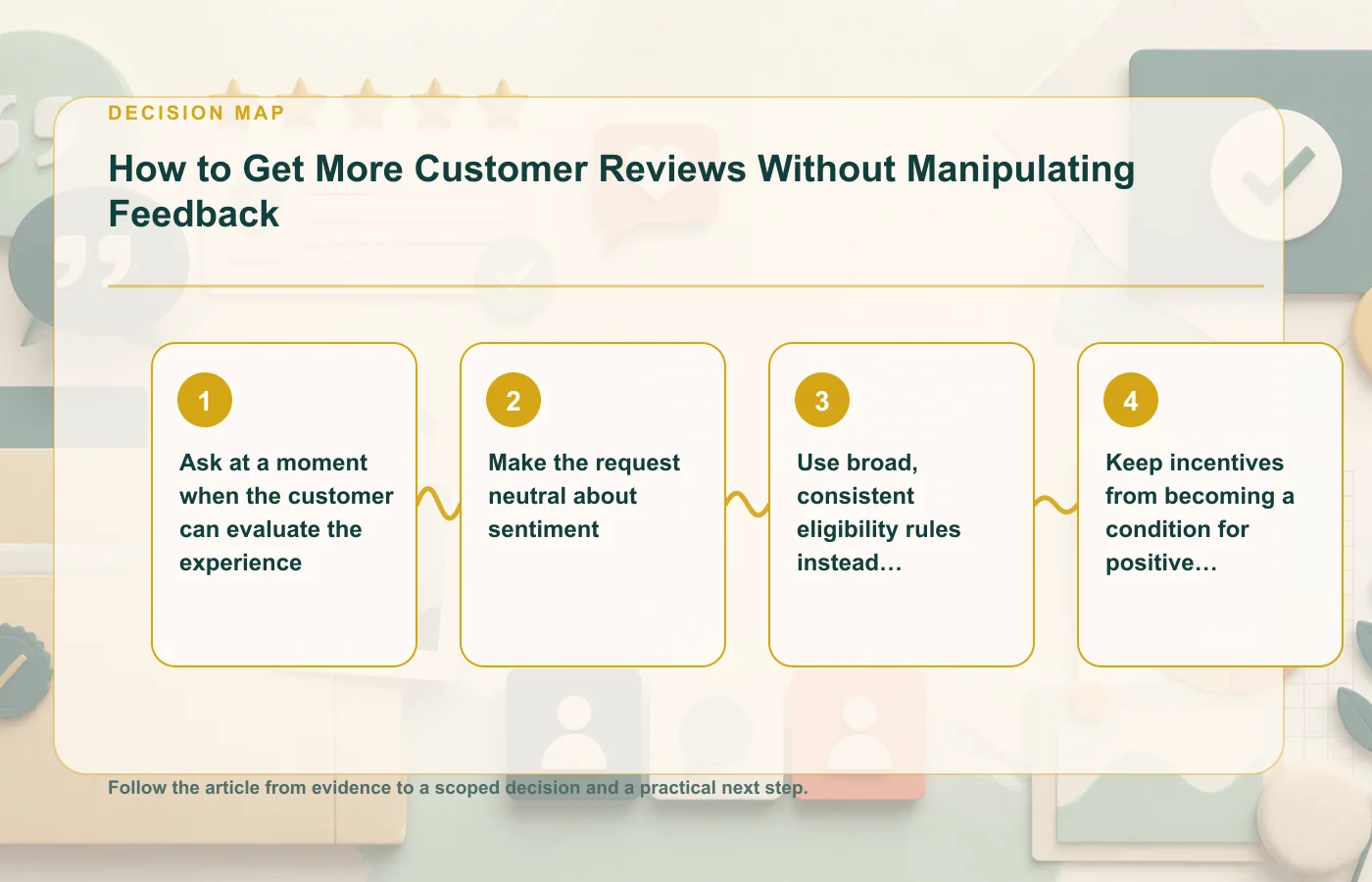
Ask at a moment when the customer can evaluate the experience
A request sent too early can produce shallow feedback and pressure customers to rate something they have not fully received or used. Define the reviewable event for each customer journey rather than setting one generic delay. For a service, that may be completion. For a delivered product, it may be after delivery and enough time to inspect or use it. For an ongoing relationship, the relevant point may be after a meaningful milestone rather than the first transaction.
Define the event before defining the delay
The important question is not "how many days should we wait?" but "what must have happened before this person can fairly evaluate the experience?" Once that event is clear, timing rules become easier to automate and audit.
- Confirm that the order, service, or interaction is complete enough to review.
- Suppress requests while a material support issue remains unresolved.
- Avoid sending duplicate requests for the same underlying experience.
- Let customers opt out of further review-request messages where the channel requires it.
That approach also produces more useful feedback. A customer who can describe the actual experience is more informative than someone responding to a request immediately after purchase.
Make the request neutral about sentiment
A review request should not tell the customer which opinion the business wants. Phrases that ask for an "honest review," "your experience," or "feedback" are directionally safer than language that asks satisfied customers to "leave five stars" or suggests that positive ratings are needed to support the business. The same destination should be available to eligible customers regardless of how the company predicts they feel.
Do not turn satisfaction surveys into review gating
A private survey can be useful for service improvement, but it should not become a gate that sends only happy respondents to a public review platform. Review gating can create a distorted picture and may violate platform rules. If the business asks a broad eligible group for public reviews, use the same neutral request path rather than branching based on an internal satisfaction score.
If negative feedback arrives, the response process is a separate workflow. The guide to responding to negative reviews covers how to handle criticism without turning collection into suppression.
Use broad, consistent eligibility rules instead of cherry-picking happy customers
Eligibility should be defined by the customer experience, not by expected sentiment. Examples of defensible criteria include a completed transaction, a finished service, a closed support interaction, or another real event that is applied consistently. Document the rule so someone auditing the program can understand why one customer received a request and another did not.
Separate operational exclusions from sentiment filters
There are legitimate reasons not to send a request at a particular moment. A duplicate order, an unresolved support case, an invalid contact method, or a customer opt-out can justify suppression. Those reasons are different from excluding someone because the business believes they are likely to leave a negative review.
| Possible exclusion | Operationally defensible? | Why |
|---|---|---|
| Experience not yet completed | Yes | The person may not be able to evaluate it yet |
| Open material support issue | Often | The request can be delayed until the interaction is reviewable |
| Customer opted out | Yes | Respect the communication preference |
| Predicted low satisfaction | No as a sentiment filter | It selectively suppresses likely negative public feedback |
| Low private survey score | No as a public-review gate | It creates different review paths based on sentiment |
A consistent rule also makes automation safer because the system can act on documented events rather than a hidden "likely promoter" score.
Keep incentives from becoming a condition for positive feedback
If a business chooses to offer an incentive for a review, the incentive must not be conditioned on positive sentiment under the FTC rule referenced in the source material. The exact offer, eligibility logic, and disclosure obligations should be reviewed before launch, and the destination platform may impose stricter requirements than the federal baseline.
Record the offer and wording used
Keep a copy of the review request, the incentive terms, the audience rule, and the destination policy relied on at approval time. That record helps later editors determine whether the program was sentiment-neutral and whether the disclosure remains adequate when the campaign or platform changes.
- Do not promise a benefit only for positive reviews.
- Do not imply that a low rating makes the customer ineligible.
- Do not hide the material connection when disclosure is required.
- Recheck platform rules before reusing an old incentive campaign.
The broader reviews and testimonials resources are useful when the question moves from review collection into publication, moderation, or display.
Design the request experience for honest participation
Volume matters less than the credibility of the process. A good program reduces friction without pushing sentiment. Keep the request concise, explain what the customer is being asked to do, link directly to the appropriate review destination, and avoid repeated reminders that feel like pressure.
Use a clear stop condition
Once the customer submits a review, opts out, or reaches the end of the planned sequence, stop asking. If the review destination changes or a support issue opens, the workflow should be able to suppress or reroute the next message. This is particularly important when requests are automated across multiple orders or locations.
The adjacent guide on online reputation management strategy explains how collected feedback can feed a wider response and improvement process without making review removal the objective.
Build one auditable eligibility rule per journey
Teams often create review problems accidentally because eligibility is scattered across CRM filters, support tags, store locations, and campaign lists. Write the rule in plain language first. For example: "send the request after the qualifying experience is complete, provided there is no unresolved material support issue and the customer has not opted out." The exact event will vary by journey, but the logic should be understandable without reverse-engineering a marketing automation.
Then map every technical exclusion back to that written rule. If a location, product line, or customer segment is excluded, record the operational reason. This makes it easier to spot exclusions that are really sentiment filters in disguise. It also gives the team something concrete to review when a platform policy changes.
Audit the message separately from the audience
A neutral audience rule does not fix biased copy. Review the request itself for steering language, implied rewards, and pressure. The customer should understand that they are free to describe the experience as they saw it. Avoid subject lines, buttons, or follow-up wording that suggest a high rating is the expected outcome.
Useful QA questions include:
- Would the same message be appropriate if the customer had a poor experience?
- Does any sentence imply that a reward depends on positive sentiment?
- Does the request make the destination and purpose clear?
- Can the customer stop receiving reminders?
- Is there a documented owner for reviewing platform-policy changes?
Measure the collection process without rewarding manipulation
Teams can monitor delivery, response, duplication, opt-outs, and workflow errors without turning "more positive reviews" into the only success metric. If staff compensation or campaign optimization depends narrowly on average rating, it can create pressure to screen customers or coach sentiment. Keep operational metrics focused on whether eligible customers are reached consistently and whether the process remains neutral.
Review volume can still be useful context, but interpret it alongside coverage. A campaign that sends requests to only a hand-picked subset may produce more flattering results while representing less of the customer base. The better question is whether the program invites feedback from the defined eligible population in a consistent way across the full defined customer journey and review-request program over time consistently.
FAQ: getting more reviews without manipulation
Can I ask only my best customers for reviews?
Using sentiment as the selection criterion is the problem. Define eligibility through a real customer event and apply it consistently instead of cherry-picking people expected to leave praise.
Can I offer an incentive for a review?
The source material says incentives cannot be conditioned on the review expressing a particular positive or negative sentiment. Material connections may need disclosure, and the destination platform can have stricter rules.
Should unhappy customers be sent to a private survey instead?
A private survey can exist for service improvement, but it should not be used to block dissatisfied customers from the public review path while satisfied customers are routed publicly.
How this page was prepared
Reviewed by Social Proofs Standards Editor. Claims, terminology, and time-sensitive details were checked against the sources listed below and the page was last updated August 19, 2026.
AI-assisted tools supported research organization or drafting; editorial review remained responsible for source selection and the published conclusions.
Sources and verification
Primary and authoritative references used to verify this article: