
Online Reputation Management: A Practical Response System
Manage reputation as an operating workflow, not an alert feed. Inventory sources, assign owners, preserve evidence, route issues correctly, and use removal only when justified.

Online reputation management is easier to control when it is treated as an operating system rather than a stream of mentions to answer. Reviews, social posts, support complaints, press coverage, and misinformation do not all belong in the same queue. They have different owners, evidence, response windows, and escalation paths. The useful first step is therefore an inventory: where reputation signals appear, who monitors each source, what can be verified, and which team can actually resolve the underlying issue.
That distinction matters because reputation work can drift into suppression. FTC rules prohibit certain review-suppression practices, so removing negative sentiment cannot be the objective. A better program separates genuine criticism, policy violations, misinformation, and coordinated abuse, then routes each type through an appropriate process. The same evidence record that supports a public response should also support internal service improvement.
| Signal | Primary owner | First question | Typical next step |
|---|---|---|---|
| Customer review | Customer experience / reputation | Is the experience identifiable and actionable? | Respond, investigate, or escalate under platform rules |
| Social mention | Social / community | Is this a support issue, commentary, or amplification risk? | Route to support or respond in-channel |
| Support complaint | Support / operations | What can be resolved privately? | Service recovery and evidence capture |
| Press or public allegation | Communications / leadership | What is verified and material? | Coordinated factual response |
| Suspected policy abuse | Reputation / legal / platform owner | What evidence supports escalation? | Preserve records and use the platform process |
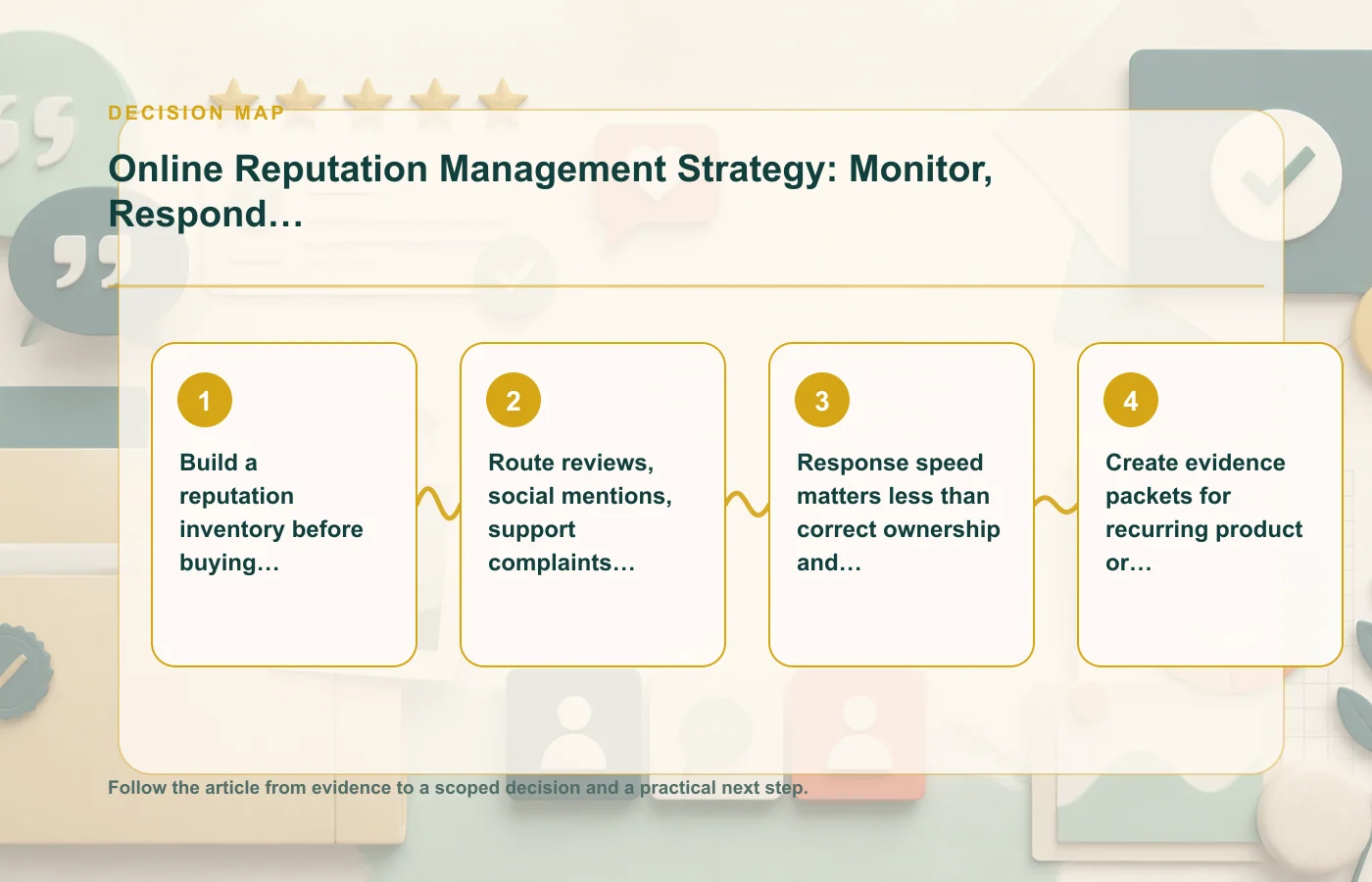
Build a reputation inventory before buying another monitoring tool
A monitoring product cannot compensate for an unclear map of reputation sources. List the places where customers and other audiences can create or discover claims about the business: review platforms, social networks, support channels, community spaces, and press coverage already included in your working scope. For each source, record who has access, who owns responses, and how the team preserves evidence when an issue becomes material.
Inventory decisions, not just channels
The most useful inventory shows what happens after a signal appears. A one-star review with a verifiable service complaint should not take the same path as a false account, a press inquiry, or an angry social post that contains no customer-identifying details. Define the decision points before alert volume grows.
- Source: where the signal appeared and whether the team can respond there.
- Evidence: what customer, transaction, message, or policy record may exist.
- Owner: which team can actually investigate or fix the issue.
- Escalation: when legal, security, leadership, or platform moderation should be involved.
- Retention: where the original content and response history are stored.
Only after that map exists does monitoring-tool selection become easier. The team can evaluate whether a tool covers the sources and workflow it actually needs instead of buying another dashboard that creates alerts without ownership.
Route reviews, social mentions, support complaints, and press separately
All reputation signals may affect public perception, but they are not interchangeable. A support ticket is a private service record. A review is customer feedback published under a platform's rules. A social mention may be conversational and fast-moving. Press coverage has a different audience and correction process. Combining them into one generic "negative mention" queue encourages the wrong response.
Create routing rules before writing response templates
Routing should answer who can establish the facts. If a review describes a failed delivery, support or operations may need to verify the record before a reputation manager replies. If a social post raises an account-security concern, the public team should avoid requesting sensitive information in the thread. If content appears to violate a platform rule, preserve the post before submitting a moderation request.
Review suppression should not become a hidden routing category. Negative but genuine customer feedback belongs in the improvement and response process, not in a removal queue simply because it is uncomfortable. For a deeper workflow on public replies, use the negative-review response guide.
Response speed matters less than correct ownership and escalation
Fast responses can be useful, but speed is not the only quality measure. A rapid reply from the wrong team can expose private information, contradict policy, promise an unavailable remedy, or escalate a dispute that should have moved to a private channel. Set service levels that include triage and ownership rather than rewarding the first person who can type a response.
Use a two-stage response model
The first stage is triage: identify the source, severity, owner, and whether immediate acknowledgement is useful. The second is resolution: investigate the underlying record, choose the correct channel, and decide whether the public thread needs an update. Some issues can be acknowledged before the investigation is complete, but the wording should not pretend that the cause or outcome is already known.
- Escalate safety, security, legal, or privacy concerns to the appropriate owner.
- Move customer-specific evidence into private channels.
- Keep public statements narrower than the internal investigation record.
- Do not let an arbitrary response-time target override fact checking.
This also makes performance reporting more honest. A team can distinguish acknowledgement time, investigation time, and resolution time instead of treating one fast public comment as proof that the issue was handled well.
Create evidence packets for recurring product or service issues
Repeated complaints become strategically useful only when the team can compare them without overstating what they represent. Build an evidence packet for recurring themes: the original customer material, relevant service or product records, how the issue was classified, what action was taken, and whether the theme changed after an operational response.
Preserve frequency carefully
A cluster of similar complaints may reveal an operational theme, but it does not automatically justify a broad claim about all customers or all transactions. Keep counts and categories tied to the source records available to the team. When evidence is incomplete, describe the limitation rather than filling the gap with an assumed trend.
Evidence packets are useful beyond reputation teams. Product, operations, support, and leadership can inspect the same source material when deciding whether a process needs to change. That turns reputation management into a feedback loop instead of a purely defensive communication function.
If a resolved issue later produces positive customer evidence, use a separate consent and publication workflow. The site's testimonial format guide is a better reference for that publishing decision than the reputation-monitoring record itself.
Do not treat review removal as the default reputation tactic
Some content can legitimately require platform moderation, but "make negative reviews disappear" is not a sound reputation strategy. FTC rules prohibit certain review-suppression practices, and a removal-first culture also destroys useful operational feedback. Separate unfavorable from policy-violating: those are different classifications.
Use removal only through a defensible process
When a review appears to violate a platform rule, preserve the original text, timestamp, account details available to the business, and any transaction evidence before escalation. Submit the issue through the platform's process and avoid publicly accusing the reviewer unless reliable evidence supports the statement. If the review is genuine criticism, route it to response and service recovery instead.
A mature program measures more than deletion. It tracks whether recurring issues reach the right owner, whether response quality improves, whether evidence is retained, and whether operational changes address the causes behind repeated complaints. The broader reviews and testimonials library can support governance questions that fall outside monitoring and response.
Define what "improve reputation" means operationally
Reputation programs often become vague because the desired outcome is described only as "better sentiment" or "more positive reviews." Those are not sufficient operating instructions. Define outcomes the team can influence without manipulating feedback: complaints reach the correct owner, response records are complete, recurring issues are identified, private information stays private, and platform escalation is supported by evidence.
This also changes how dashboards should be read. A sudden increase in complaints can reflect a real service problem, a change in volume, a new source being monitored, or a concentrated incident. Do not treat a single chart as self-explanatory. Keep the underlying source and classification method available so people reviewing the report can understand what changed.
| Operational measure | What it tells you | What it does not prove |
|---|---|---|
| Unassigned issues | Whether triage is working | Customer satisfaction |
| Time to acknowledged ownership | How quickly the correct team takes responsibility | That the issue was resolved |
| Recurring issue categories | Where similar complaints are appearing | How common the problem is outside the observed records |
| Evidence-complete escalations | Whether moderation or internal review has a defensible record | That a platform will remove the content |
| Closed-loop actions | Whether findings reached product, service, or operations | That public sentiment will immediately improve |
Assign a periodic review owner as well. Platform rules, internal processes, products, and customer-contact channels change. A routing map that was accurate when it was created can become misleading if no one is responsible for maintaining it. Review the channel inventory, response permissions, escalation contacts, and evidence-retention rules whenever the operating context changes.
Finally, keep reputation reporting separate from performance marketing claims. An internal pattern can justify investigation or a service change without automatically becoming publishable proof. If a team later wants to turn a resolved theme into a case study, testimonial, or public claim, start a new evidence and permission review for that asset rather than reusing the internal reputation packet as marketing copy. That boundary keeps internal diagnosis useful while preventing a limited operational sample from being presented publicly as representative customer evidence across the wider customer base or broader market overall.
FAQ: building a reputation management workflow
Do I need a monitoring tool to start?
No. The source material supports building the channel inventory, ownership, evidence, and escalation process first. A tool is useful when it matches that workflow rather than defining it for you.
Should every negative mention be answered?
No single rule fits every channel. Respond when a public reply can clarify, resolve, or route the issue responsibly. Some signals require private handling, monitoring, or platform escalation instead.
How should recurring complaints be reported?
Report them with the underlying evidence and clear definitions. Do not turn a small or incomplete set of complaints into a broad claim about all customers, and keep source records available for review.
How this page was prepared
Reviewed by Social Proofs Standards Editor. Claims, terminology, and time-sensitive details were checked against the sources listed below and the page was last updated August 14, 2026.
AI-assisted tools supported research organization or drafting; editorial review remained responsible for source selection and the published conclusions.
Sources and verification
Primary and authoritative references used to verify this article: