
Fake Review Detection: Signals and Response Protocol
Investigate suspicious reviews with evidence, not intuition. Combine multiple signals, preserve the original record, avoid public accusations, and use platform moderation separately.
Fake review detection should be treated as triage, not as a machine for declaring that an inconvenient review is fraudulent. A suspicious pattern can justify investigation, but unusual wording, timing, or rating is not proof on its own. The defensible process combines account signals, timing, language, transaction evidence, and platform rules, then separates internal customer-service handling from the platform's moderation decision.
FTC rules prohibit fake or false reviews, but that does not give a business license to publicly accuse an individual reviewer based on a hunch. Preserve the original content and metadata, investigate what can be verified, and escalate through the relevant platform process when the evidence supports it. If the review describes a real customer problem, handle that problem even if other aspects of the account look unusual.
| Signal | What it may justify | What it does not prove by itself |
|---|---|---|
| Unusual account activity | Closer account or platform review | That the review is fabricated |
| Clustered timing | Pattern analysis across related reviews | Coordinated abuse |
| Repeated or generic language | Comparison with other content | That the writer is not a real customer |
| No matching transaction found | Request for more information or platform escalation | That no legitimate experience occurred |
| Conflicting transaction evidence | Documented investigation | Permission to publicly expose private records |
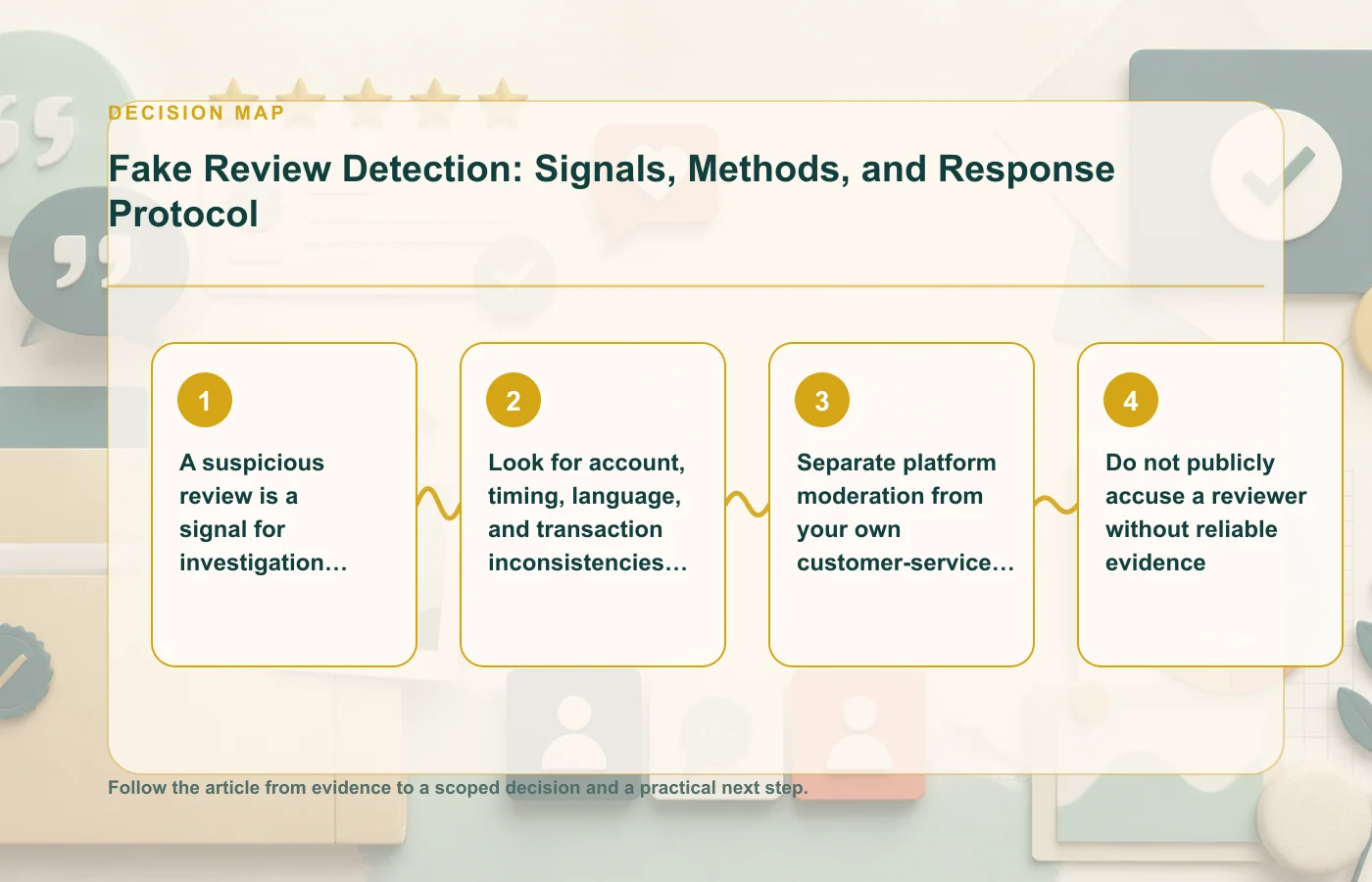
A suspicious review is a signal for investigation, not proof of fraud
The safest starting point is to classify what made the review suspicious. "It feels fake" is not a useful evidence category. Note the observable signal: timing, account history available to you, language overlap, transaction mismatch, or another specific inconsistency. Then ask what additional evidence would be needed before taking action.
Use a confidence ladder
- Observation: record the unusual feature without assigning motive.
- Corroboration: check whether other independent signals point in the same direction.
- Transaction review: see whether relevant customer or order evidence can confirm or contradict the account.
- Platform review: compare the evidence with the platform's moderation rules.
- Action: respond, investigate, or submit a removal request through the appropriate process.
This keeps the business from converting a detection heuristic into an accusation. A reviewer can use odd language and still describe a real experience. Conversely, a realistic-sounding review can still violate policy. The process should depend on evidence, not on style alone.
When a suspicious review also contains a service complaint, keep the complaint in the customer-service lane. The online reputation management strategy guide explains how to route issues without making removal the default objective.
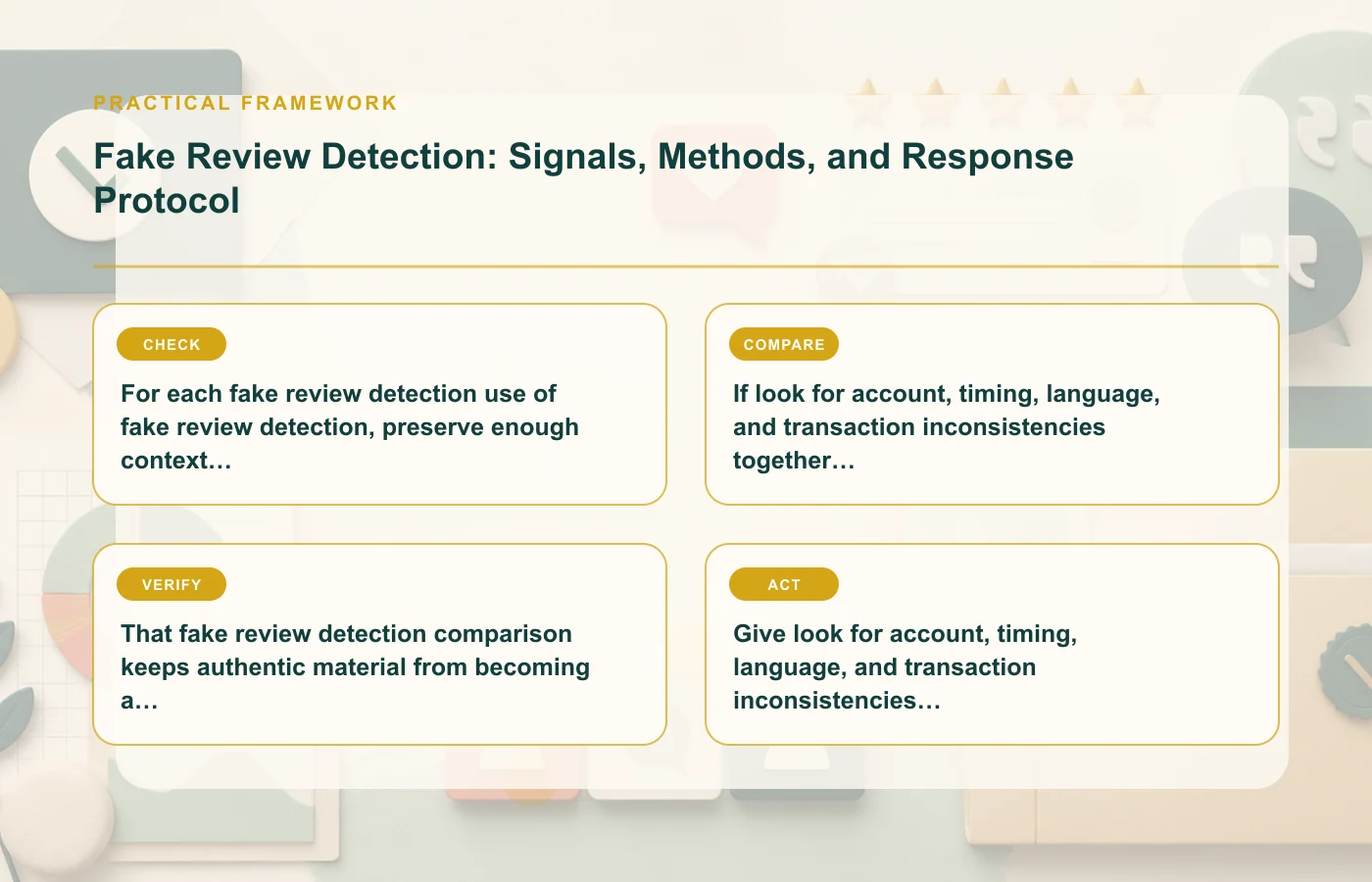
Look for account, timing, language, and transaction inconsistencies together
Detection becomes more useful when multiple signals are considered together. A single phrase, a sudden rating, or an account created recently can have innocent explanations. A cluster of inconsistencies may deserve closer investigation, but even then the conclusion should remain proportional to the evidence.
Combine signals without turning them into a score you cannot explain
If the team uses an internal score or tool, preserve the inputs behind the flag. An unexplained "92% fake" label is not a substitute for evidence. Record which account, timing, language, or transaction features triggered review and what the human investigator checked next.
- Compare timestamps with known customer or campaign events.
- Look for repeated language across related reviews without assuming duplication equals fraud.
- Check whether a transaction, support interaction, or service record can be matched.
- Note discrepancies without publishing private customer information.
- Keep false-positive examples so the detection process can be improved.
Detection systems are triage tools. Platform investigation and transaction evidence are better suited to deciding whether content violates policy.
Separate platform moderation from your own customer-service response
A business may have two legitimate tasks at once: responding to a customer-facing complaint and asking a platform to investigate whether a review violates its rules. Do not merge them. The public response should address the review responsibly without threatening the reviewer with removal, while the moderation packet should contain the evidence needed by the platform.
Build a defensible escalation packet
| Packet element | Purpose |
|---|---|
| Original review text | Preserves what was actually published |
| Timestamp and visible account details | Establishes the platform context |
| Relevant transaction or support record | Shows what can or cannot be matched |
| Observed inconsistencies | Explains why moderation is requested |
| Platform rule relied on | Connects the request to a policy rather than dissatisfaction |
Do not attach more private customer data than the platform process requires. The evidence packet is an escalation tool, not a public rebuttal.
If the review turns out to be legitimate criticism, the moderation workflow should be able to stop and hand the issue back to service recovery. The goal is correct classification, not proving the original suspicion right.
Do not publicly accuse a reviewer without reliable evidence
A public accusation can create a second reputational problem. Saying "this review is fake" communicates a factual conclusion that may not be established. If the business cannot match the reviewer to a record, a narrower response is safer: state that the team cannot currently identify the transaction and invite the reviewer to provide details privately.
Keep public wording narrower than the investigation
Internal teams can examine account patterns, order data, timestamps, and other evidence. The public reply usually needs much less. Avoid posting screenshots of customer records, payment details, staff notes, or other private evidence to prove the company's position.
If reliable evidence eventually supports a moderation request, use the platform process. If the evidence remains ambiguous, document the uncertainty. A suspicious review does not have to be publicly branded as fraudulent for the team to watch the pattern or improve its detection model.
For response language when criticism is public, see how to respond to negative reviews.
Preserve the original review and metadata before requesting removal
Content can change or disappear during an investigation. Preserve the original review before taking action: text, date, visible account details, rating, relevant thread context, and the internal records used to evaluate it. That gives the team a stable record even if the platform later edits, removes, or hides the content.
Keep the evidence chain readable
- Store the original content separately from analyst notes.
- Date each investigation step.
- Identify which signals were observed and which were inferred.
- Record the platform policy and submission used for escalation.
- Keep the final moderation outcome with the original packet.
This record is also useful for improving detection. If a suspicious review is ultimately validated as genuine, keep that false-positive example. It helps the team avoid over-weighting the same signal in the future.
The review collection guide is relevant when the broader issue is building a fair pipeline of genuine customer feedback rather than investigating one suspicious item.
Use detection tools as triage, not final judgment
Automated or manual detection methods can prioritize reviews for attention, but the final decision should be tied to evidence and the relevant platform rules. A tool may spot linguistic similarity, timing clusters, or account anomalies that a human misses. It can also misclassify ordinary behavior.
Document why a flag exists
For every flagged review that reaches manual investigation, make the reason visible. Analysts should be able to distinguish "tool flagged this because of repeated wording" from "transaction records contradict a specific factual claim." Those are different levels of evidence and should not lead automatically to the same action.
| Detection stage | Output |
|---|---|
| Automated flag | Priority for review, not a fraud conclusion |
| Human triage | Observable signals and information gaps |
| Evidence check | Corroboration, contradiction, or unresolved uncertainty |
| Platform escalation | Policy-based request supported by the retained packet |
This makes the process explainable and reduces pressure to treat a detection score as a verdict.
Review detection patterns at the system level
Individual investigations can reveal problems in the detection process itself. Schedule periodic reviews of confirmed violations, genuine reviews that were incorrectly flagged, unresolved cases, and reviews that escaped detection until later. The aim is not to produce a perfect fraud score; it is to understand which signals are useful for triage and which create too many false positives.
When the team changes a rule, record why. For example, if repeated phrasing turns out to be common among legitimate reviews in a particular category, reduce the weight of that signal rather than repeatedly forcing analysts to override it. If transaction mismatch is useful only after a specific data-sync delay, build that timing into the workflow.
| Review outcome | What to learn |
|---|---|
| Confirmed platform violation | Which signals and records made the escalation defensible? |
| Genuine review incorrectly flagged | Which heuristic produced the false positive? |
| Unresolved case | What evidence was unavailable, and should the case remain open? |
| Late-detected abuse | Which signal or data source was missing from initial triage? |
Keep detection and reputation incentives separate
A team judged mainly on removing negative reviews can develop an unconscious bias toward calling criticism fake. Avoid success metrics that reward deletion without regard to the moderation outcome or evidence quality. Better operational measures include evidence-complete escalations, false-positive review, time to correct classification, and whether legitimate complaints reach the service team.
This separation is important because fake-review enforcement and customer experience have different goals. Moderation asks whether content violates a rule. Service recovery asks whether a customer issue can be resolved. A single review can require investigation in both systems, and one process should not erase or distort the other when decisions are reviewed internally much later.
FAQ: fake review detection
Does unusual wording mean a review is fake?
No. Unusual language is a signal that can be compared with other evidence, not proof of fraud on its own.
What if I cannot find the reviewer in my customer records?
Treat the mismatch as one investigation signal. Ask for details privately or use the platform process when appropriate; do not assume that a missing match proves the experience never happened.
Should I respond publicly while requesting removal?
You can separate the two workflows. Keep the public response focused on responsible customer handling, and keep the moderation request focused on evidence and platform rules.
How this page was prepared
Reviewed by Social Proofs Standards Editor. Claims, terminology, and time-sensitive details were checked against the sources listed below and the page was last updated September 4, 2026.
AI-assisted tools supported research organization or drafting; editorial review remained responsible for source selection and the published conclusions.
Sources and verification
Primary and authoritative references used to verify this article: