
How to Respond to Negative Reviews: Practical Templates
Respond to negative reviews with a process that protects customer privacy and keeps disputed facts out of public arguments. Use adaptable templates for common complaint types.
A negative review is not only a support problem. It is also a public record that future customers may read while deciding whether a business is responsive, fair, and careful with personal information. A useful reply therefore has two audiences: the reviewer who had the experience and the next person evaluating how the company handles problems. The goal is not to win an argument in public. It is to acknowledge what can be acknowledged, move sensitive or disputed details into the right channel, and leave a clear path toward resolution.
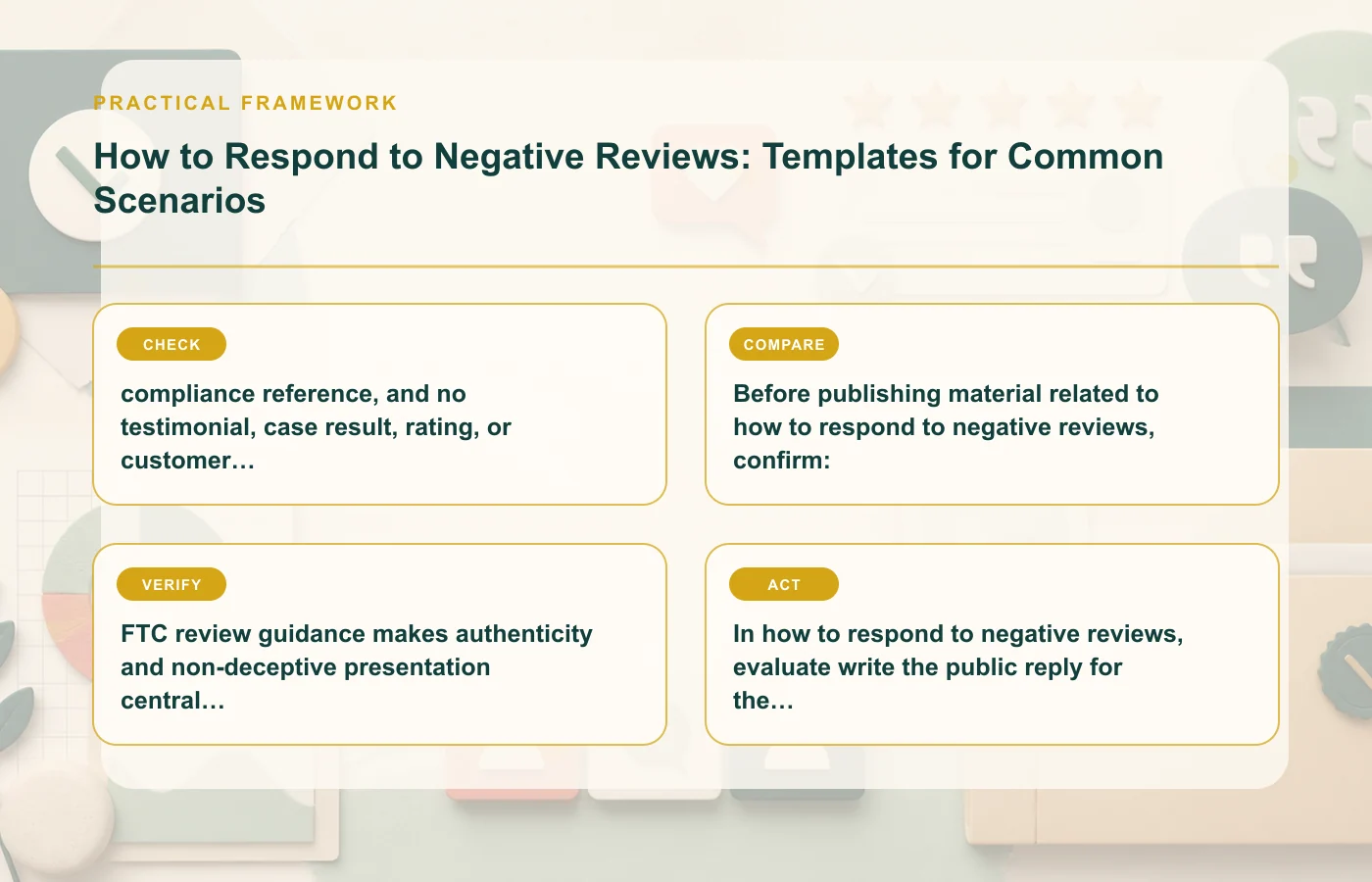
FTC review guidance makes authenticity and non-deceptive presentation central. A response process should not threaten, suppress, or distort truthful negative feedback. That makes restraint part of the workflow: verify what you know, do not imply facts you cannot support, and keep account, health, order, or other private details out of the public thread.
| Review situation | What the public reply should do | What belongs in private |
|---|---|---|
| Delay or missed expectation | Acknowledge the experience and explain the next step | Order, booking, or account details |
| Quality complaint | Recognize the concern without inventing a cause | Inspection, refund, replacement, or support record |
| Billing dispute | Confirm that the issue will be reviewed | Invoices, payment data, account history |
| Staff-conduct complaint | Take the concern seriously and avoid public blame | Internal investigation and personnel details |
| Mistaken identity or disputed facts | State that the record cannot yet be matched | Verification evidence and platform escalation |
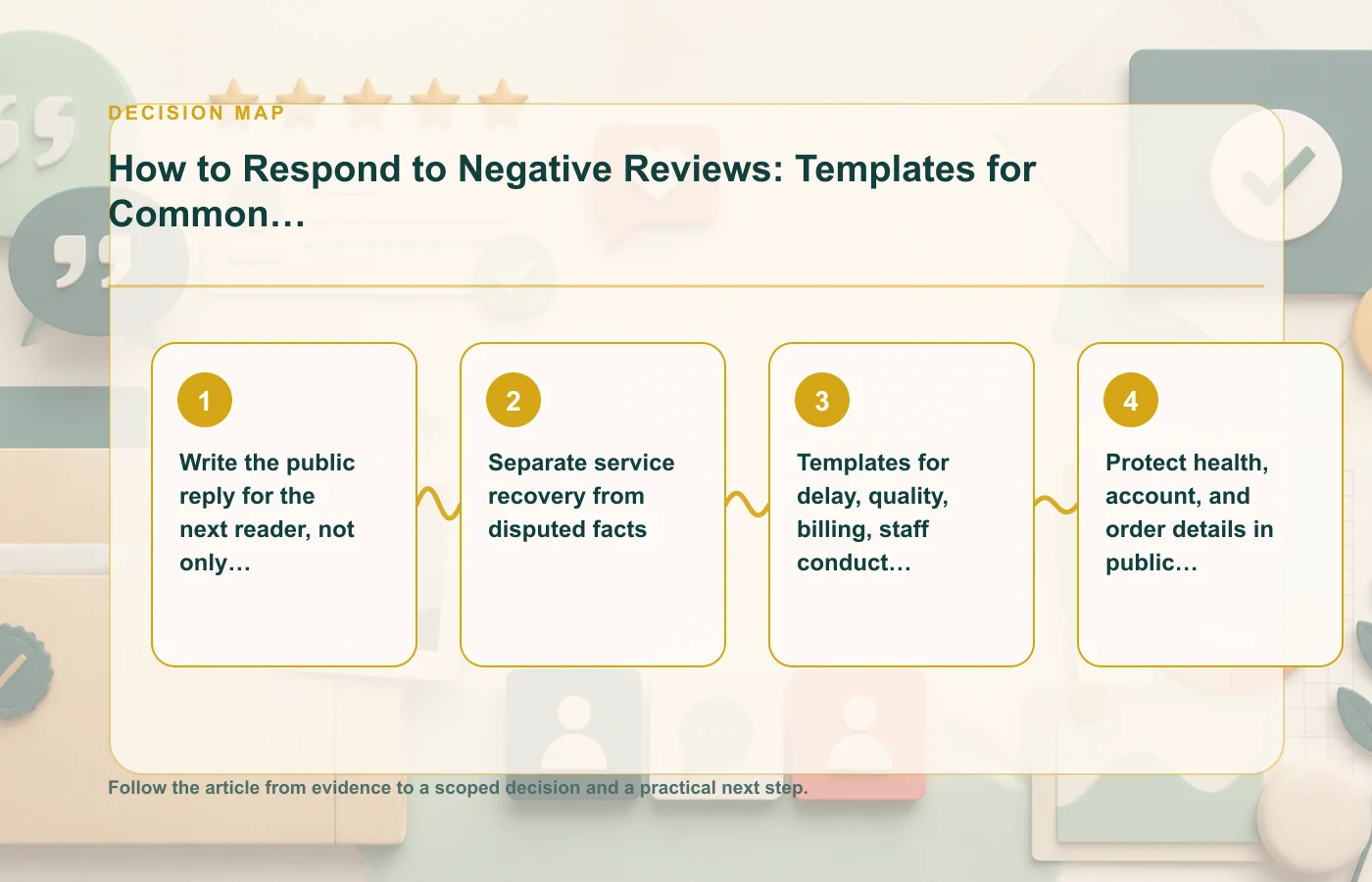
Write the public reply for the next reader, not only the reviewer
A public response should make sense even to someone who knows nothing about the original incident. Start with the part that is safe and useful to say publicly: acknowledge the concern, show that the business has a process for handling it, and identify a reasonable next step. Avoid turning the reply into a chronological defense of every event. Long rebuttals often make the company look more interested in being right than in resolving the underlying problem.
Use a simple three-part structure
- Acknowledge the issue. Refer to the customer's stated experience without pretending that disputed details have already been verified.
- Set the boundary. Explain that account-specific or sensitive information cannot be handled in a public thread.
- Give a next action. Direct the reviewer to the appropriate support path or explain what information is needed to investigate.
This structure also helps prevent accidental overstatement. Saying "we want to review what happened" is different from admitting a cause you have not confirmed. Likewise, thanking someone for raising an issue does not require agreeing with every allegation in the review. The response can be empathetic without becoming an unsupported factual statement.
If your wider site uses testimonials or other customer proof, the same evidence discipline applies. The article on credible website testimonial formats is useful when the question shifts from responding to criticism to presenting positive customer evidence responsibly.
Separate service recovery from disputed facts
Many difficult reviews contain two different problems at once. One is operational: a customer wants a refund, replacement, explanation, repair, correction, or another form of service recovery. The other is factual: the business and reviewer may disagree about what happened. Treating those as one public argument makes resolution harder.
Resolve what can be resolved first
A business can often offer a support path without taking a public position on every disputed fact. For example, a reply can say that the team will review the record and contact the customer through the appropriate channel. That keeps the public statement narrow while allowing the internal process to examine order history, messages, staff notes, or other evidence.
Do not use the reply as cross-examination
Questions that require identifying information, medical details, payment history, or account records should move to a private channel. If the reviewer has made a claim that the business cannot match to a customer record, say that carefully. Do not jump from "we cannot locate this transaction" to "this review is fake." A missing match is a reason to investigate, not proof of deception.
- Keep a copy of the review and the public response.
- Record which team owns the follow-up.
- Separate verified facts from assumptions or recollections.
- Update the public thread only when there is a useful, non-sensitive reason to do so.
If the recovery process later leads to a request for a testimonial, keep that request separate from the complaint resolution. The guide to asking for testimonials with consent covers that distinct workflow.
Templates for delay, quality, billing, staff conduct, and mistaken identity
Templates are useful when they standardize tone and safeguards, not when they force every complaint into the same story. Build reusable frameworks around the type of response rather than a fixed admission. The person replying should still read the review, check the available facts, and remove any sentence that assumes something the business has not verified.
Delay or missed deadline
Lead with the customer's missed expectation, then give a concrete support route. Avoid promising an outcome before the team has checked what is possible. A useful template has placeholders for the next step and contact method, not for invented explanations.
Quality complaint
Recognize the product or service concern and invite the customer to provide the information needed for review. Do not publicly diagnose the cause from a short review. If a return, replacement, inspection, or service process exists, describe the process accurately rather than implying a result.
Billing or account dispute
Keep payment and account details out of the response. State that the billing concern will be reviewed through a secure channel. Avoid asking the customer to post invoice numbers, phone numbers, addresses, or other identifiers publicly.
Staff conduct or mistaken identity
For conduct complaints, do not publicly expose employee details or prejudge an internal review. For mistaken identity, say that the business cannot currently match the described experience to its records and invite private verification. If platform moderation becomes relevant, preserve the evidence before making a removal request.
Protect health, account, and order details in public responses
A response can become risky even when the company is factually correct if it reveals information the reviewer did not choose to publish. Public threads are not the place to confirm a person's account status, treatment history, purchase details, address, payment method, support history, or other private information. The safest rule is simple: if resolving the issue requires looking up an individual record, move that part of the conversation to a controlled channel.
Match the level of detail to what is already public
Do not "prove" your side by posting screenshots, order records, or staff notes. Even when a reviewer has disclosed some details, that does not automatically make the full record appropriate for publication. Keep the public reply focused on process: what the company can investigate, where the customer can contact the team, and what will happen next.
Moderation and privacy safeguards should also apply consistently. A business should not be more aggressive with critical reviewers than with positive ones. The broader reviews and testimonials guidance can help when the issue concerns how customer feedback is collected, displayed, or governed rather than how one complaint is answered.
Build an internal response checklist before publishing
A good public reply is usually short, but the internal check behind it should be more complete. Before posting, confirm who owns the case, whether the customer record has been found, which statements are verified, and whether the draft exposes information that should stay private. If the response refers to a refund, replacement, policy, or support commitment, make sure that promise matches the actual process available to the customer.
It also helps to separate tone review from fact review. A courteous sentence can still be inaccurate, and a factually correct sentence can still be needlessly confrontational. Read the draft once for evidence and once from the perspective of a future customer who has no context beyond the review and the reply.
- Remove sarcasm, blame, and speculation about the reviewer's motives.
- Do not repeat inflammatory language merely to rebut it.
- Keep the response proportionate to the complaint.
- Use the same escalation criteria regardless of whether the rating is positive or negative.
- Retain the final response with the underlying case record so future editors can understand what was known at publication time and why the wording was finally approved.
FAQ: responding to negative reviews
Should every negative review receive a public response?
Not necessarily. The useful question is whether a reply can clarify the next step, show responsible handling, or correct a material misunderstanding without escalating the dispute. A repetitive or defensive reply may add little value.
What if the reviewer is clearly wrong?
Correct only the facts you can support, and keep the correction narrow. If the dispute requires private records to prove your position, move the evidence review off the public page rather than publishing sensitive information.
Can a business ask a platform to remove a negative review?
Platform moderation can be appropriate when content violates the platform's rules, but review removal should not become a substitute for handling legitimate criticism. Preserve the original review and relevant evidence before escalating it.
How this page was prepared
Reviewed by Social Proofs Standards Editor. Claims, terminology, and time-sensitive details were checked against the sources listed below and the page was last updated August 10, 2026.
AI-assisted tools supported research organization or drafting; editorial review remained responsible for source selection and the published conclusions.
Sources and verification
Primary and authoritative references used to verify this article: