
How to Ask for a Testimonial: Questions, Email Templates, and Consent
A repeatable testimonial request process covering timing, useful interview questions, editing permission, incentives, disclosure, and follow-up.
The easiest way to collect weak testimonials is to ask, "Would you say something nice about us?" It signals the desired sentiment and gives the customer no useful memory prompt. A better request follows a real outcome and asks about the customer's starting point, decision, experience, and result.
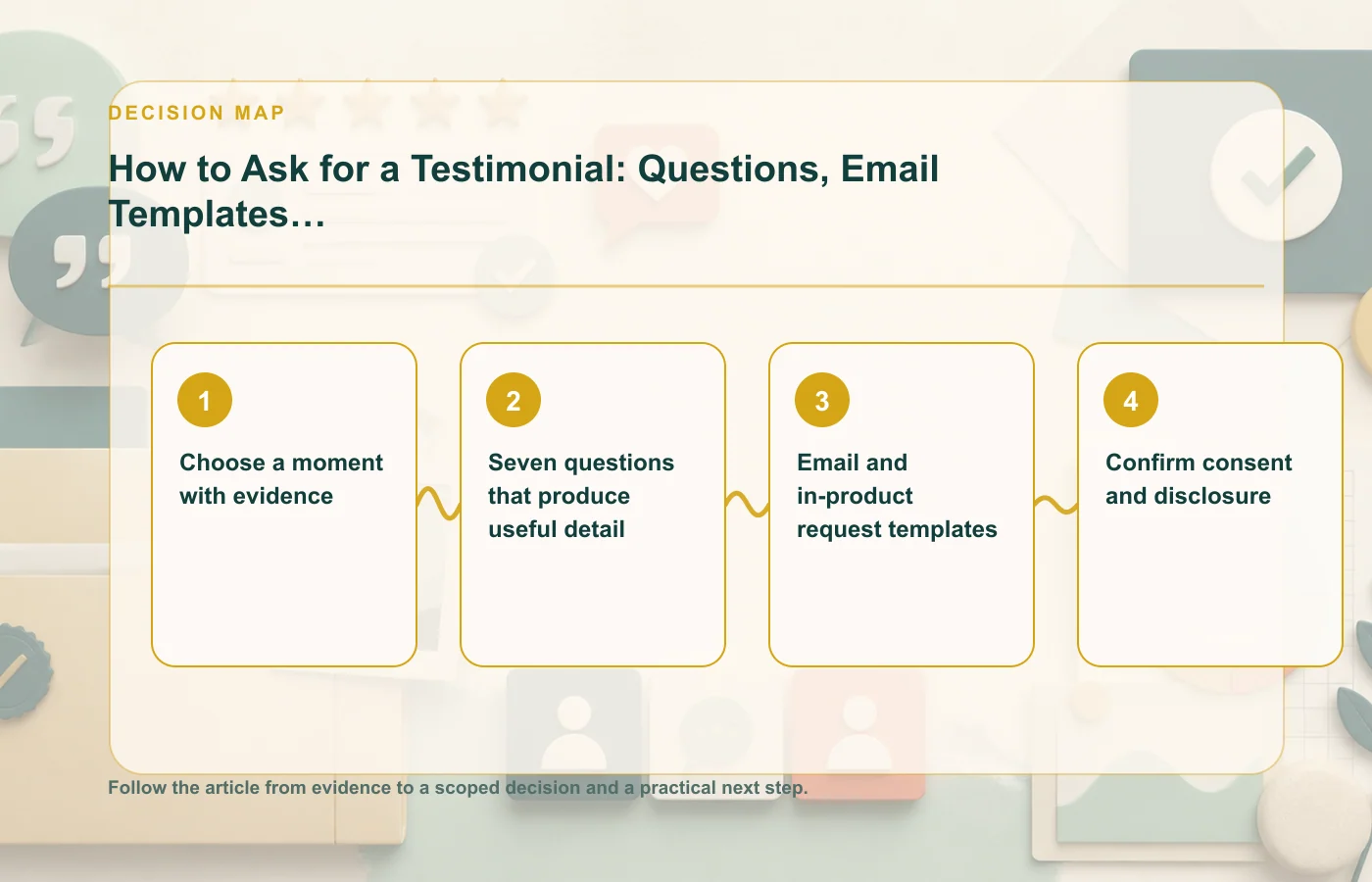
Choose a moment with evidence
Trigger the request after a task has been completed, an outcome has been observed, a support issue has been resolved, or the customer has voluntarily expressed useful feedback. Do not ask on first login or before the customer has had a fair chance to evaluate the experience.
| Signal | Request | Delay when |
|---|---|---|
| Project accepted | Ask about process and result | Key stakeholders have not reviewed the work |
| Milestone reached | Ask about the starting point and measured change | The metric is still provisional |
| Positive support reply | Ask about the service experience | The underlying issue is not fully resolved |
| Renewal | Ask why the customer continued | The renewal happened automatically or under dispute |
Seven questions that produce useful detail
- What were you trying to do? Establish the job and audience.
- What was difficult before? Capture the baseline without exaggeration.
- What alternatives did you consider? Reveal the decision criteria.
- What did you actually use or change? Tie the story to a real intervention.
- What happened next? Ask for observable outcomes and time frame.
- What did not change, or what still needs work? Preserve limits and credibility.
- Who would find this most useful? Help future readers judge fit.
Send two or three questions at a time, not all seven by default. For a written quote, the smallest useful request often asks about the prior situation, the change, and one outcome.
Email and in-product request templates
Subject: Could we document what changed?
Hi [Name], now that [specific milestone] is complete, would you be open to answering three short questions about the experience? Honest detail is more useful than praise, and you can approve the final wording, attribution, and where it appears before anything is published. No problem if the timing is not right.
Thank you for explaining what worked. May we adapt that feedback into a short website testimonial? We would send the exact quote and attribution for approval first. Please also tell us whether you prefer your full name, first name and role, company only, or anonymous attribution.
Would you describe what you completed today? Your answer may be considered for a customer example only if you separately approve publication.
Confirm consent and disclosure
- Explain the intended channels: website, sales material, ads, social posts, or email.
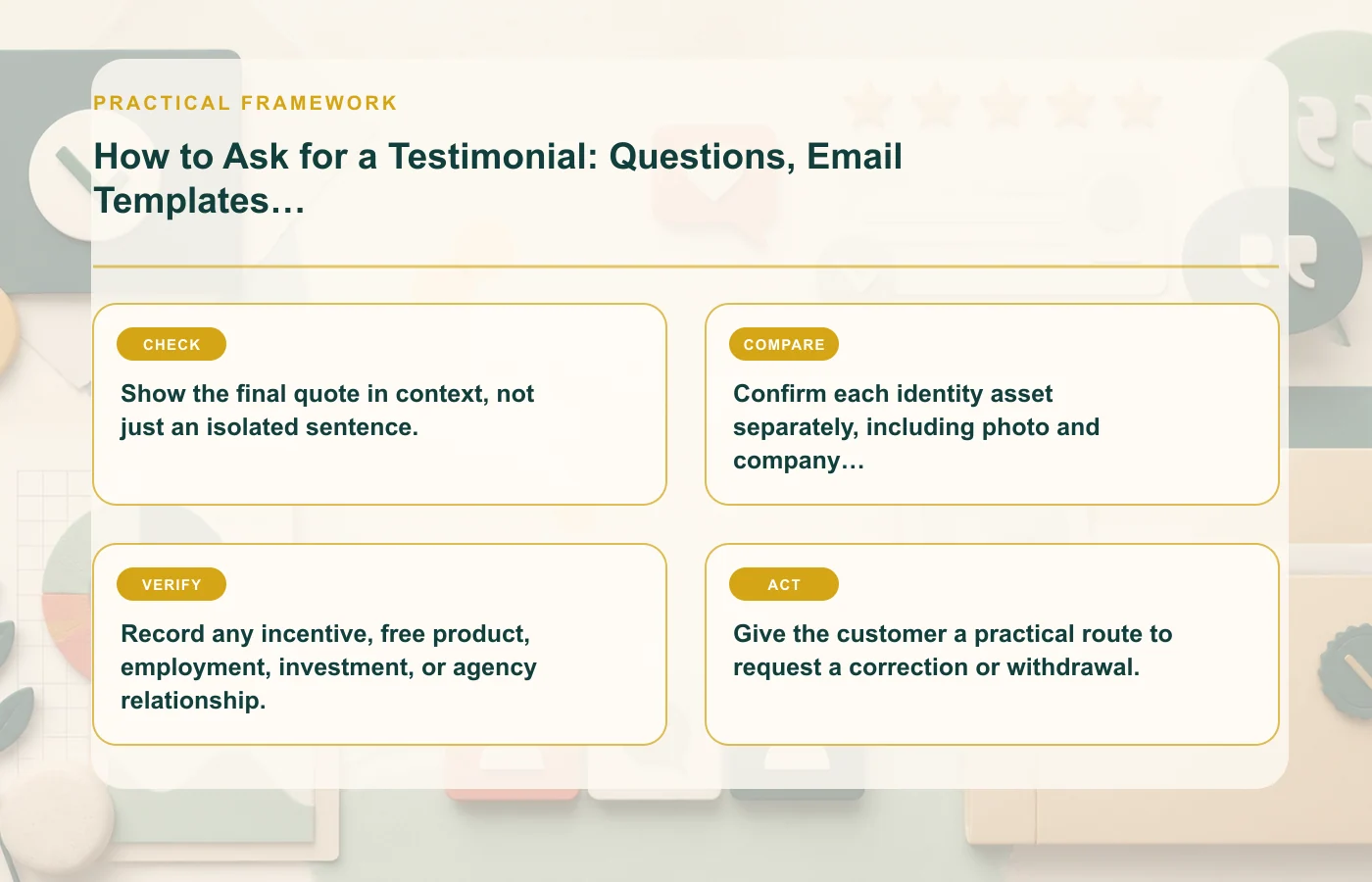
- Show the final quote in context, not just an isolated sentence.
- Confirm each identity asset separately, including photo and company logo.
- Record any incentive, free product, employment, investment, or agency relationship.
- Give the customer a practical route to request a correction or withdrawal.
- Store the approval date and schedule a factual review.
Current FTC guidance says an incentive must not be conditioned, expressly or implicitly, on a positive review. Material connections may also need clear disclosure. A neutral request for honest feedback is safer than "Tell us how much you loved it for a coupon."
For the display step, use the formats in our website testimonial examples. For a deeper outcome story, move to the customer case study template.
Sources
How this page was prepared
Reviewed by Social Proofs Standards Editor. Claims, terminology, and time-sensitive details were checked against the sources listed below and the page was last updated August 6, 2026.
AI-assisted tools supported research organization or drafting; editorial review remained responsible for source selection and the published conclusions.
Sources and verification
Primary and authoritative references used to verify this article: