
Customer Case Study Template: From Baseline to Verifiable Result
A modular case study template for documenting the customer context, starting point, intervention, evidence, outcome, and meaningful limitations.

A customer case study is not a long testimonial. It is a documented explanation of a starting condition, an intervention, and an outcome. Its value comes from preserving enough context for another person to decide whether the result is relevant to their own situation.
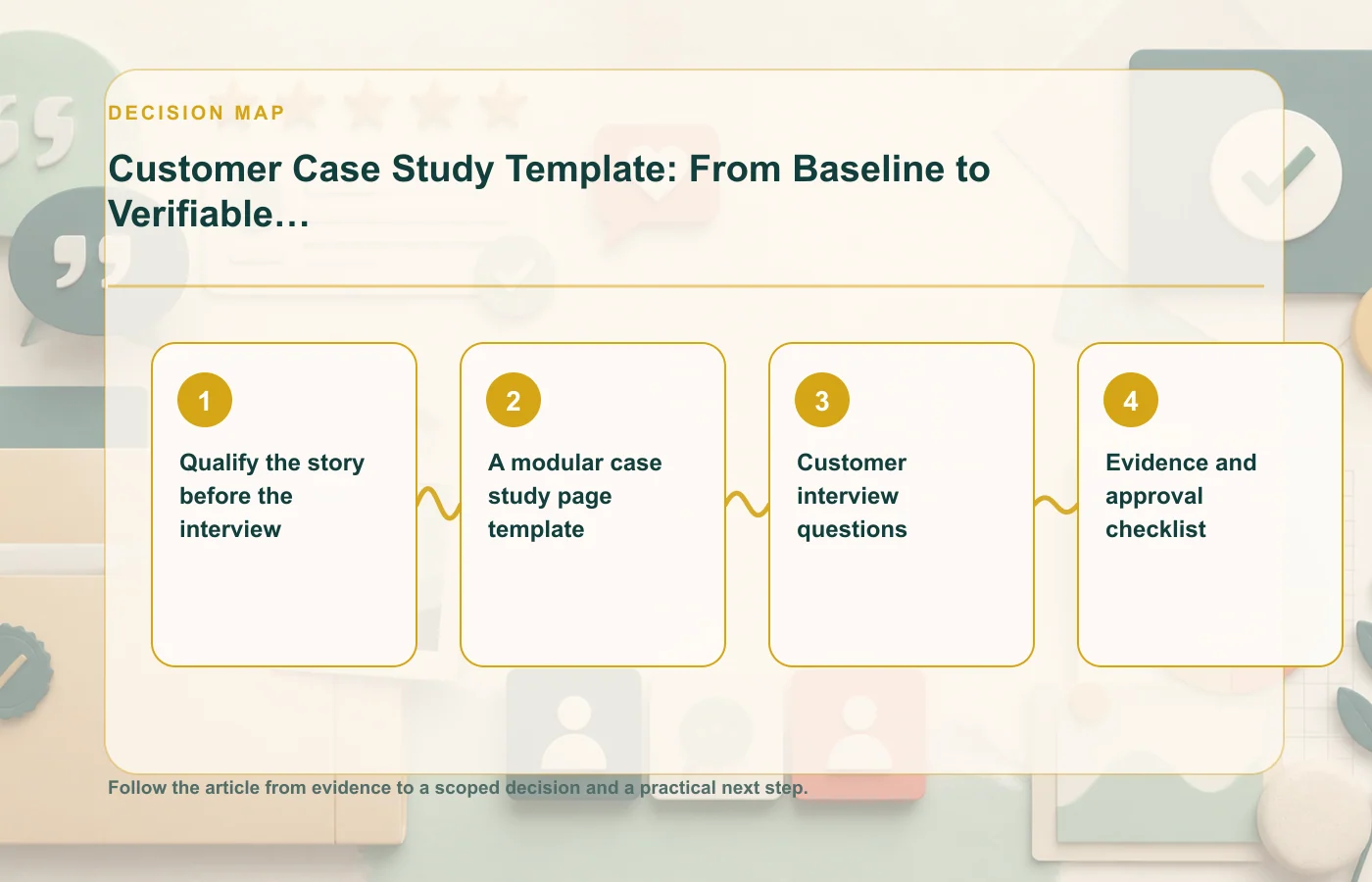
Qualify the story before the interview
Choose a case because it represents a useful decision, audience, or implementation pattern, not simply because it produced the largest number. Confirm that the customer can discuss the work, the outcome has stabilized, and the underlying records can support the central claim.
Does the story match a real prospect question?
Can the baseline and result be checked?
Can the intervention be described without hiding dependencies?
Can the customer authorize facts, identity, and publication?
A modular case study page template
- Descriptive title: name the audience, work, and observed outcome without turning the headline into an unsupported guarantee.
- Evidence strip: list industry, organization size, period, products or services used, and measurement source.
- Starting point: describe the prior process, baseline metric, constraints, and why change was considered.
- Decision: explain the alternatives and criteria. Include the customer's own words when they add context.
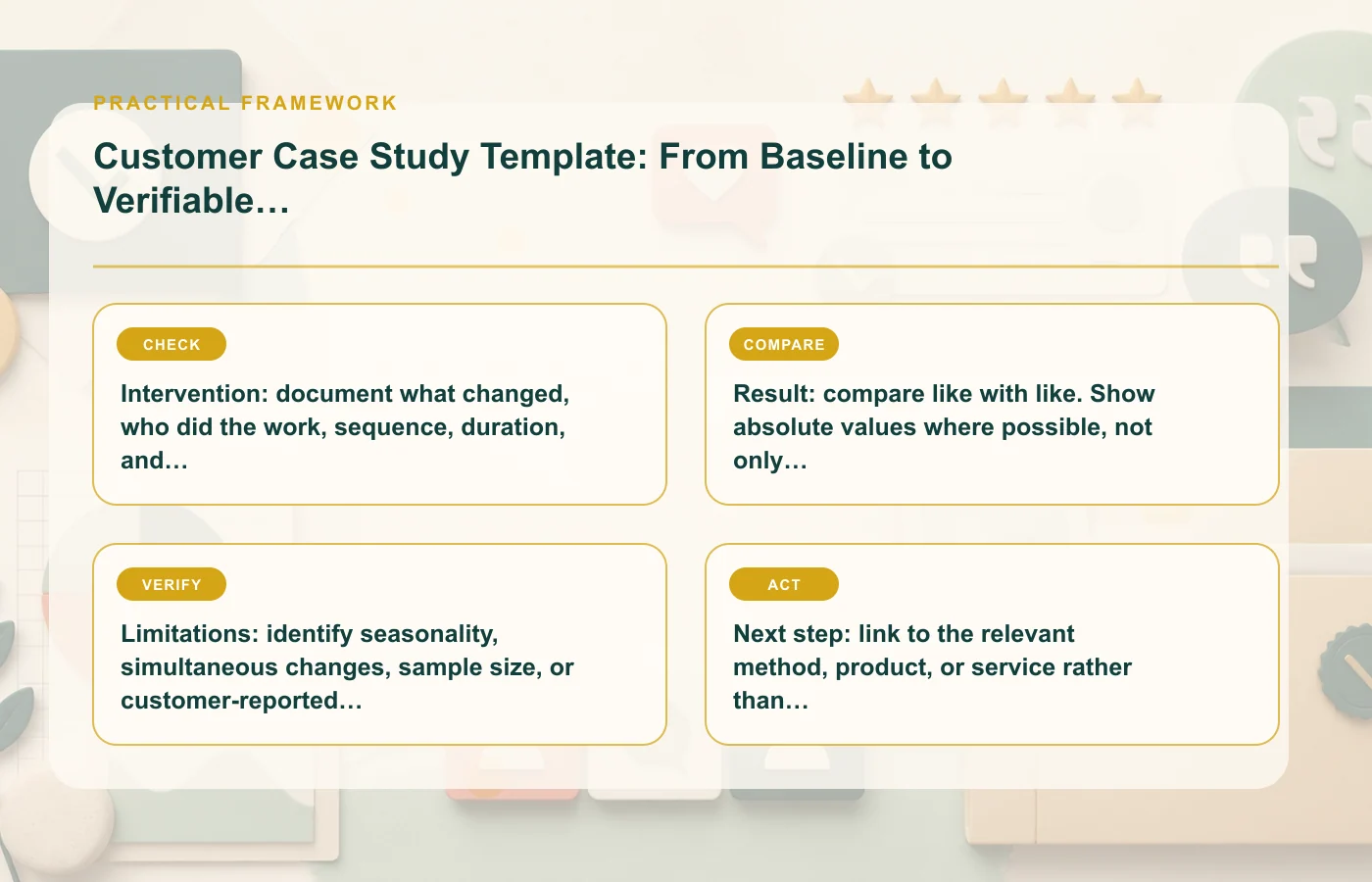
- Intervention: document what changed, who did the work, sequence, duration, and dependencies.
- Result: compare like with like. Show absolute values where possible, not only a large percentage.
- Limitations: identify seasonality, simultaneous changes, sample size, or customer-reported data.
- Next step: link to the relevant method, product, or service rather than a generic company CTA.
Organization: 14-person support team
Period: January through March
Baseline: median first response of 11 hours
Intervention: routing rules and weekday coverage change
Observed result: median first response of 4.5 hours
Source: help-desk export reviewed by both teams
Limit: excludes weekends and priority incidents
Customer interview questions
- What did the old process look like on an ordinary day?
- Which cost, delay, error, or risk made the change important?
- What alternatives were evaluated, and which criteria mattered?
- What work did your team complete versus the provider or product?
- How long did implementation and adoption take?
- Which metric best represents the change, and where does it come from?
- What else changed during the same period?
- What did not work as expected?
- Who is likely to see a different result, and why?
Evidence and approval checklist
| Claim | Useful record | Approval owner |
|---|---|---|
| Baseline and result | Export, report, invoice, analytics definition | Data owner |
| Implementation | Project plan, configuration record, delivery log | Project lead |
| Customer quote | Recording or original written response | Speaker |
| Name, logo, photo | Explicit usage permission | Authorized contact |
| Commercial relationship | Discount, compensation, investment, agency terms | Publisher |
Publish a review date and assign an owner. A case study can become misleading when the customer changes roles, the product changes materially, or a once-current metric remains presented as ongoing.
Constraints make a case study more useful. They help readers distinguish an observed result from a universal promise and often reveal the conditions required to reproduce the work.
Sources
How this page was prepared
Reviewed by Social Proofs Standards Editor. Claims, terminology, and time-sensitive details were checked against the sources listed below and the page was last updated August 6, 2026.
AI-assisted tools supported research organization or drafting; editorial review remained responsible for source selection and the published conclusions.
Sources and verification
Primary and authoritative references used to verify this article: