
B2B and SaaS Case Study Examples: Evidence Structures
Study SaaS and B2B case studies for their evidence structure, not their claims. Focus on customer context, implementation, measurable outcomes, limitations, and provenance.

B2B and SaaS case studies are useful to study for their evidence architecture, not for claims or screenshots another company happens to use. The transferable part is the structure: who the customer was, what operating constraint created the need, what changed, how the change was measured, which implementation conditions mattered, and where the result has limits.
A credible case study does not ask the reader to trust a headline in isolation. It connects every important result to enough context that someone can evaluate it. Customer approval should cover quoted language and brand assets used in the final page, while charts, screenshots, and metrics need provenance just like prose. The design can make the evidence easier to scan, but it cannot create evidence that is not there.
| Case-study layer | What the reader needs | Evidence record to retain |
|---|---|---|
| Customer context | Role, situation, operating environment | Approved description and customer identity/permission |
| Problem | The constraint that made action necessary | Source interview, notes, or customer-approved wording |
| Intervention | What was actually implemented or changed | Implementation record and scope |
| Result | What changed and how it was measured | Metric definition, baseline, period, supporting source |
| Limits | Conditions, dependencies, or tradeoffs | Customer context and editorial notes |
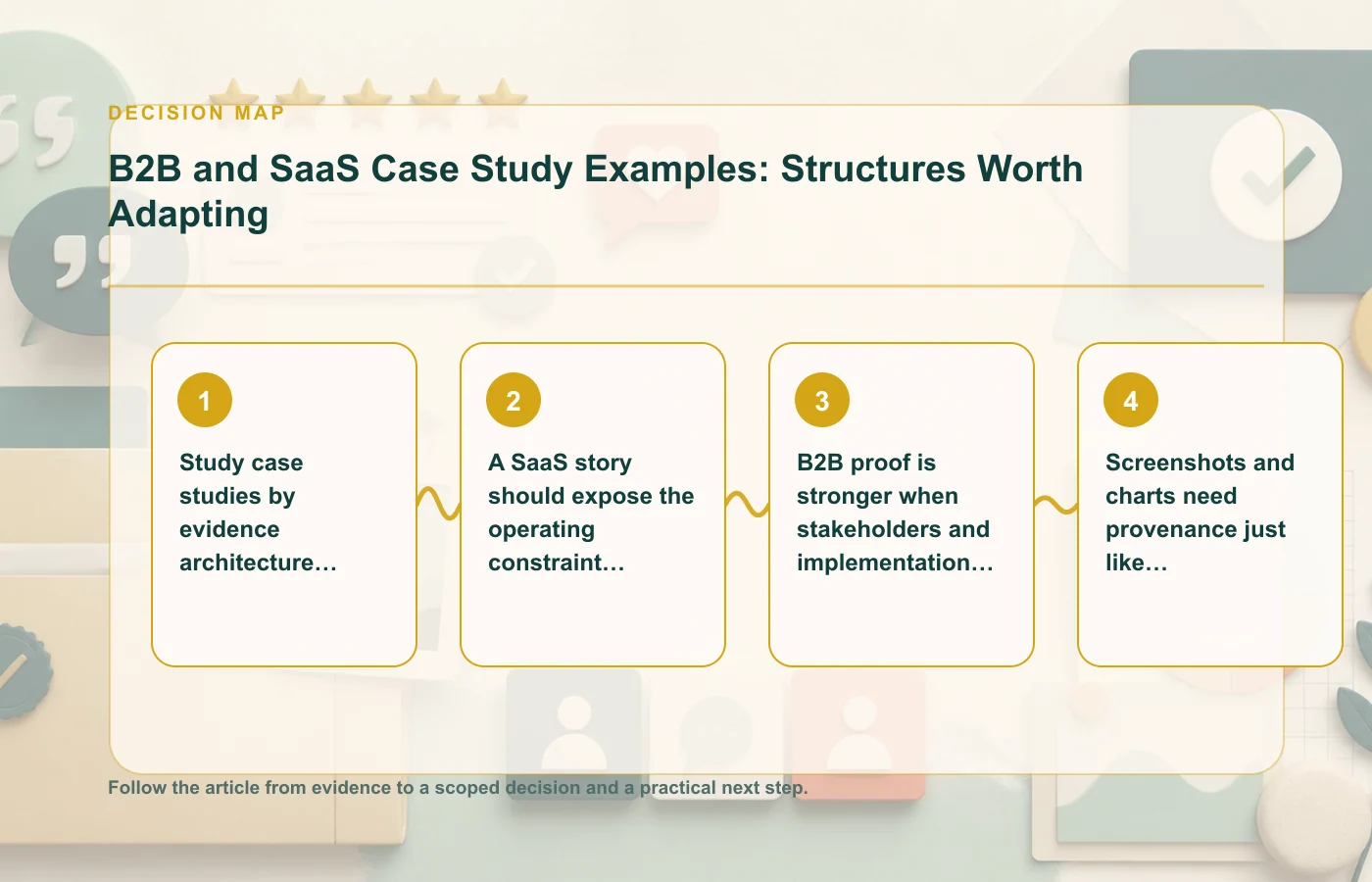
Study case studies by evidence architecture, not by visual style
When reviewing a strong B2B or SaaS story, ignore the brand colors and hero design for a moment. Ask how the page lets a reader move from context to claim. Does the result appear next to the definition needed to understand it? Can you tell what the customer actually said versus what the vendor wrote? Are implementation conditions visible, or does the story jump from problem to outcome as if nothing happened in between?
Reverse-engineer the information sequence
- Situation: who had the problem and in what operating context?
- Constraint: what made the status quo insufficient?
- Decision: why was a change considered?
- Implementation: what was actually done?
- Evidence: what changed, how was it measured, and over what period?
- Qualification: what limits or conditions should stay attached?
This sequence is reusable even when the underlying customer, product, metric, and market are completely different. Copying another brand's numbers, screenshots, or customer claims is not.
For a broader page-by-page trust framework, see trust signals for websites. The connection is evidence placement, not copying proof from another company.
A SaaS story should expose the operating constraint behind the purchase
"The customer wanted to grow" is rarely enough context. Stronger stories explain the operating condition that made the decision meaningful: a process that did not scale, a workflow with too much manual effort, a visibility gap, an implementation requirement, or another constraint actually present in the source evidence. The case study should not invent severity merely to make the story dramatic.
Describe the before-state in observable terms
Ask what the customer was doing before, where the limitation appeared, who was affected, and what a successful change needed to preserve. This gives the reader a basis for deciding whether the case resembles their own situation.
- What process existed before the change?
- What made it insufficient or costly to continue?
- Which stakeholders were involved?
- What constraints shaped implementation?
- What outcome was the customer actually trying to reach?
The story should remain customer-specific. Do not convert one organization's constraint into a universal statement about an industry unless separate evidence supports that claim.
B2B proof is stronger when stakeholders and implementation conditions are clear
B2B outcomes often depend on more than a product feature. Adoption, integrations, internal ownership, process changes, data quality, training, or other implementation conditions can shape what happened. If those conditions are part of the customer's story, leaving them out can make the result look easier or more automatic than it was.
Show enough implementation to interpret the outcome
The page does not need to become a technical manual, but it should tell the reader what materially changed. Identify the relevant stakeholders, the scope of the implementation, and any condition without which the result would be misleading. This is especially important when the customer outcome could otherwise look like a guaranteed consequence of purchase.
Customer approval should cover the quoted language and any brand assets used in the final page. Preserve the final approved version so later editors do not expand the scope, add new claims, or reuse the customer logo in a context that was not reviewed.
The case studies resource library is a useful next step when the question is how multiple case-study formats fit into the wider evidence program.
Screenshots and charts need provenance just like quoted metrics
Visual evidence can feel self-explanatory, but it still needs a source. A dashboard screenshot may show a number without explaining the definition, period, baseline, or filters. A chart can make a change look dramatic while hiding the comparison frame. Treat every visual as a claim-bearing asset.
Build a visual-evidence record
| Visual | Questions to document |
|---|---|
| Dashboard screenshot | What system, date, metric definition, account scope, and filters does it represent? |
| Before/after image | Are the conditions comparable, and what changed between the two states? |
| Chart | What is the source data, period, baseline, and calculation? |
| Workflow diagram | Is it a factual customer process or a simplified company-authored illustration? |
Do not rely on the visual alone if the reader needs methodology to interpret it. Put the qualification beside the chart or link directly to supporting detail. If the source cannot be reconstructed, replace the visual with a narrower statement rather than relying on apparent precision.
The site's case study template can help translate this evidence architecture into a repeatable production process.
Adapt the structure without copying the proof
The main lesson from case-study examples is how to organize evidence. You can adapt the sequence, navigation, table structure, interview questions, or methodology placement while using only your own verified customer material. This is the safest distinction between inspiration and imitation.
Create a reusable production checklist
- Confirm customer permission and approved identity/brand assets.
- Preserve the source interview or evidence file.
- Define every metric and baseline used.
- Show implementation conditions that materially affect interpretation.
- Keep company-authored analysis separate from customer quotes.
- Retain the final customer-approved version.
Once that checklist exists, design can vary by campaign without changing the evidence standard. A short landing page and a long case-study PDF can use different presentation while drawing from the same approved record.
Use examples to improve interviewing, not to pre-write the customer story
One of the easiest ways to weaken a case study is to decide the narrative before interviewing the customer. A team sees a strong example, copies its "challenge → solution → result" arc, and then asks questions designed to fill predetermined blanks. The structure can still be useful, but the evidence must decide what the actual story is.
Prepare an interview around areas rather than conclusions. Ask the customer to describe the before-state, decision process, implementation, observed change, and limitations. If the strongest evidence turns out to be operational rather than financial, let the page reflect that. If a hoped-for metric cannot be verified, do not force it into the template simply because another case study has a prominent number.
Separate the customer voice from the vendor analysis
A case study normally contains both. The customer can describe their experience, while the company may explain product features, implementation steps, or methodology. Readers should be able to tell which is which. Do not place company-authored performance language inside quotation marks, and do not present an editorial interpretation as if the customer endorsed that exact wording.
Before publication, compare all quotes with the source interview and all outcome statements with the evidence record. Then give the customer the agreed approval opportunity for quoted language and brand assets. If the customer revises a statement, update the evidence file rather than keeping an older, stronger version because it reads better.
Plan for reuse without losing context
Case-study material is often reused in sales decks, landing pages, social posts, and email campaigns. Create short approved extracts only after the full story is stable. Each extract should retain enough context to avoid turning a qualified result into a universal promise.
| Reuse format | Context most likely to be lost | Safeguard |
|---|---|---|
| Quote card | Customer situation and qualification | Keep meaningful attribution and avoid changing the claim |
| Metric tile | Baseline, period, and definition | Keep the metric note or link to methodology |
| Sales slide | Implementation conditions | Include the condition when it changes interpretation |
| Social clip | Surrounding answer | Check the short clip against the full source |
This reuse discipline lets one approved story support several channels without gradually becoming stronger than the underlying customer evidence.
FAQ: learning from SaaS and B2B case-study examples
What should I copy from another company's case study?
Copy the information architecture if it is useful: the sequence, evidence placement, or navigation concept. Do not copy customer claims, metrics, screenshots, or other underlying proof.
How much implementation detail belongs in a case study?
Enough to understand what materially shaped the result. If leaving out a condition makes the outcome appear automatic or guaranteed, the context is too thin.
Do screenshots count as evidence on their own?
Not necessarily. A screenshot still needs provenance and may require metric definitions, dates, filters, baselines, or other context to be interpretable.
How this page was prepared
Reviewed by Social Proofs Standards Editor. Claims, terminology, and time-sensitive details were checked against the sources listed below and the page was last updated August 26, 2026.
AI-assisted tools supported research organization or drafting; editorial review remained responsible for source selection and the published conclusions.
Sources and verification
Primary and authoritative references used to verify this article: