
Website Testimonial Examples: 12 Credible Formats to Adapt
Twelve testimonial structures with realistic copy anatomy, verification cues, placement guidance, and notes on what makes each format believable.
A useful testimonial lets a prospective customer recognize a situation, evaluate an experience, and decide whether the result is relevant. The quote does not need dramatic language. It needs details that would be difficult to invent accidentally.
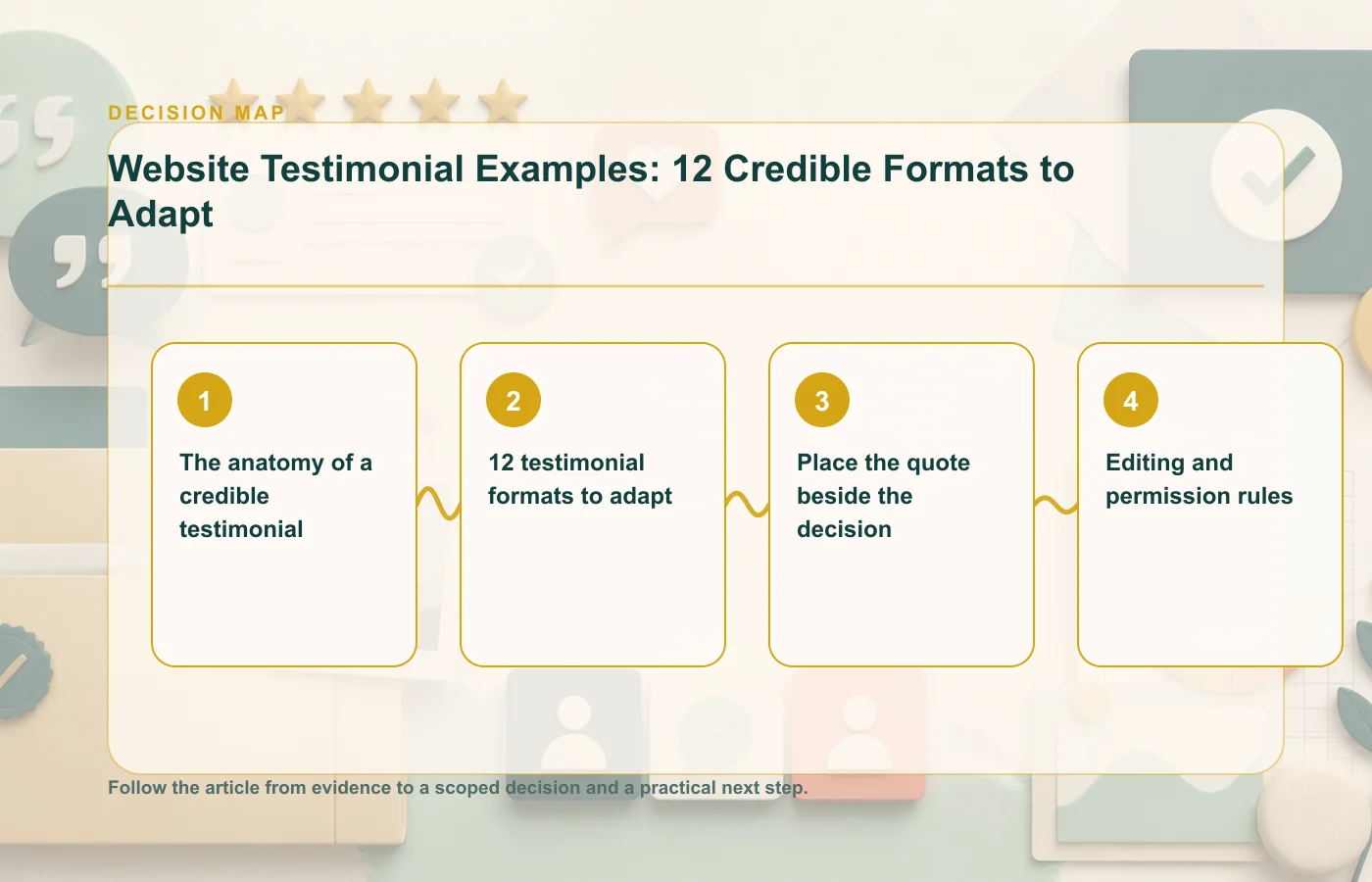
The anatomy of a credible testimonial
"Before the change, our team reconciled the report in three spreadsheets every Friday. After moving the approval step into one workflow, the handoff takes about 20 minutes and exceptions are visible to both teams."
Why it works: the reader sees the old process, change, measured outcome, and scope. The statement can then be attributed to a named role, organization, date, and source with permission.
Compare that with "This tool changed everything." The second quote is shorter, but it gives the reader no way to judge fit, meaning, or credibility.
12 testimonial formats to adapt
Before / after quote
One sentence describes the prior workflow; the next names the change and current outcome.
Objection answered
The customer names an initial concern and explains what evidence changed the decision.
Role-specific outcome
Frame the result around the work of a recognizable role, such as an operations lead or solo founder.
Feature-in-context
Connect one feature to the task it supported instead of praising the entire product.
Short video answer
Ask one focused question, provide captions and transcript, and show the speaker's relevant context.
Audio clip plus transcript
Preserve voice while giving visitors a fast, accessible way to scan the exact statement.
Third-party review excerpt
Quote a narrow passage, name the source, show the date, and link back where licensing permits.
Metric with method
Pair the customer's result with baseline, period, measurement source, and important dependencies.
Mini case-study card
Use four fields: situation, intervention, evidence, outcome. Link to the complete story.
Comparison testimonial
Let the customer explain what they evaluated and why this option fit, without unsupported competitor claims.
Customer FAQ answer
Use a real customer's answer to a question prospects repeatedly ask, with editorial context.
Long-term update
Return after 30, 90, or 365 days to show whether the initial benefit persisted or changed.
Place the quote beside the decision
| Page | Useful testimonial | What to avoid |
|---|---|---|
| Home | Concise category and audience validation | A rotating wall of unrelated praise |
| Feature or service | Outcome tied to that exact capability | Company-wide statement with no feature detail |
| Pricing | Value, implementation, support, or switching evidence | A quote that hides cost or plan context |
| Checkout or form | Relevant reassurance plus clear policy links | Distracting autoplay or fake recent-sales alerts |
| About | Experience of working with the people or process | Product claims duplicated from sales pages |
Editing and permission rules
- Keep a record of the original response and the approved public version.
- Correct spelling or shorten only when the meaning and level of certainty remain intact.
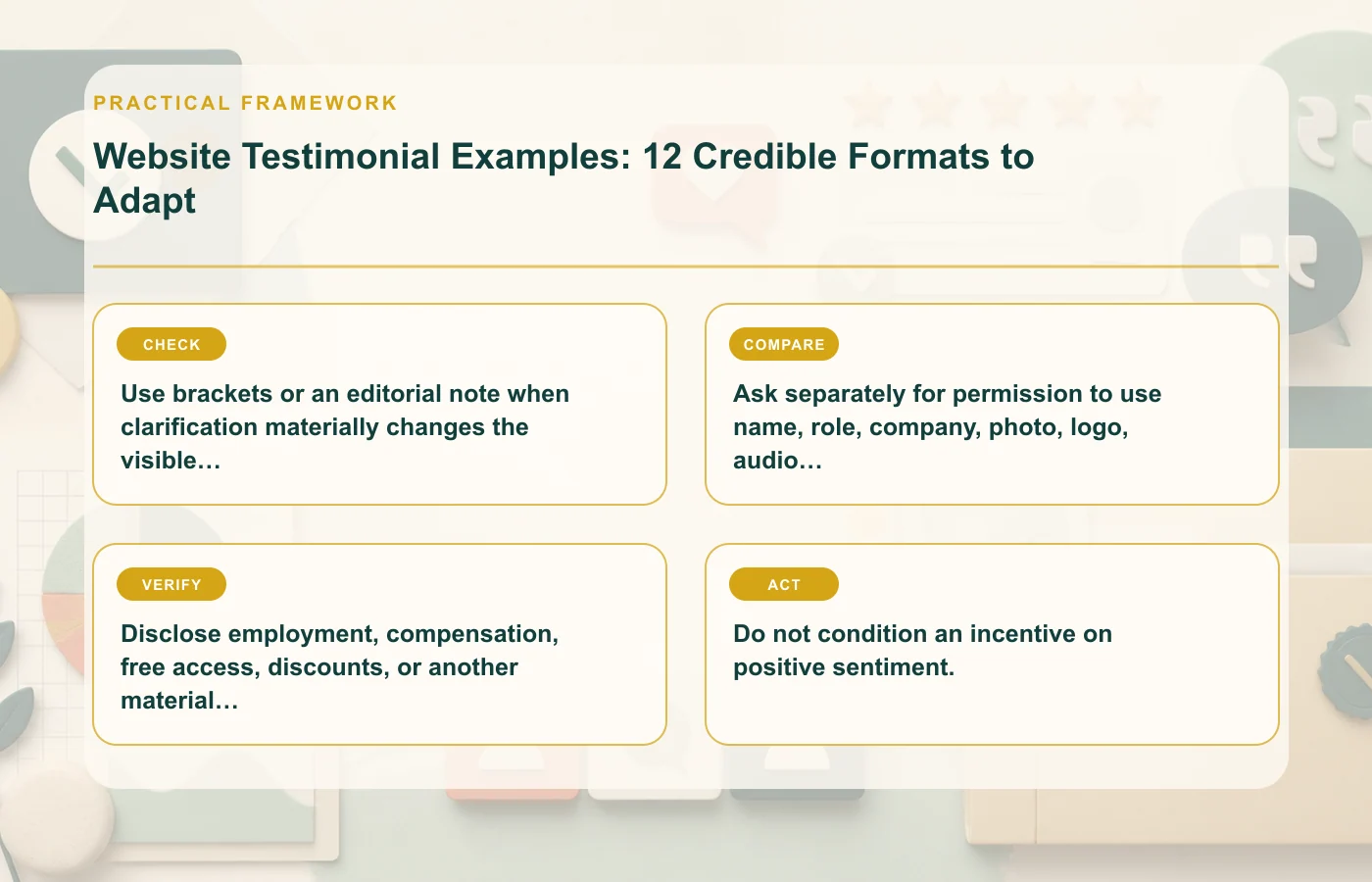
- Use brackets or an editorial note when clarification materially changes the visible wording.
- Ask separately for permission to use name, role, company, photo, logo, audio, and video.
- Disclose employment, compensation, free access, discounts, or another material relationship.
- Do not condition an incentive on positive sentiment.
- Define a review date so stale claims and former roles are updated or removed.
Remove the praise. If the quote still teaches the reader something specific about the situation, process, or outcome, it is probably useful. If nothing remains, interview again.
Source
How this page was prepared
Reviewed by Social Proofs Standards Editor. Claims, terminology, and time-sensitive details were checked against the sources listed below and the page was last updated August 6, 2026.
AI-assisted tools supported research organization or drafting; editorial review remained responsible for source selection and the published conclusions.
Sources and verification
Primary and authoritative references used to verify this article: