
Social Proof on Landing Pages: Placement and Testing
Use landing-page social proof as evidence, not decoration. Match proof to the adjacent claim, preserve attribution, choose the right format, and isolate variables in tests.
Social proof on a landing page is useful only when it supports the claim beside it. A testimonial about helpful support cannot prove product performance. A customer logo cannot prove a quantified result. A case-study link provides a different level of evidence from a short quote. Placement should therefore follow the reader's question, not a rule that says "put testimonials above the fold."
FTC guidance requires truthful presentation of endorsements and material connections. That means the page needs a source record behind each proof element and enough attribution or disclosure for the audience to interpret it correctly. Testing can optimize presentation, but it should not turn a weak claim into a stronger one or falsely attribute a lift to social proof when several page elements changed at once.
| Landing-page area | Reader question | Useful proof type | Guardrail |
|---|---|---|---|
| Hero | Is this relevant and credible? | Concise attributed testimonial, customer proof, or case-study cue | Do not make a broad claim from a narrow quote |
| Value proposition | Why should I believe this specific benefit? | Proof directly tied to the adjacent claim | Match evidence to the claim |
| Mid-page objection | Will this work in my situation? | Case-study excerpt, UGC, quote, methodology cue | Keep context and attribution |
| Decision/CTA area | Is the next step trustworthy? | Relevant customer evidence or real trust information | Avoid manufactured urgency or unsupported guarantees |
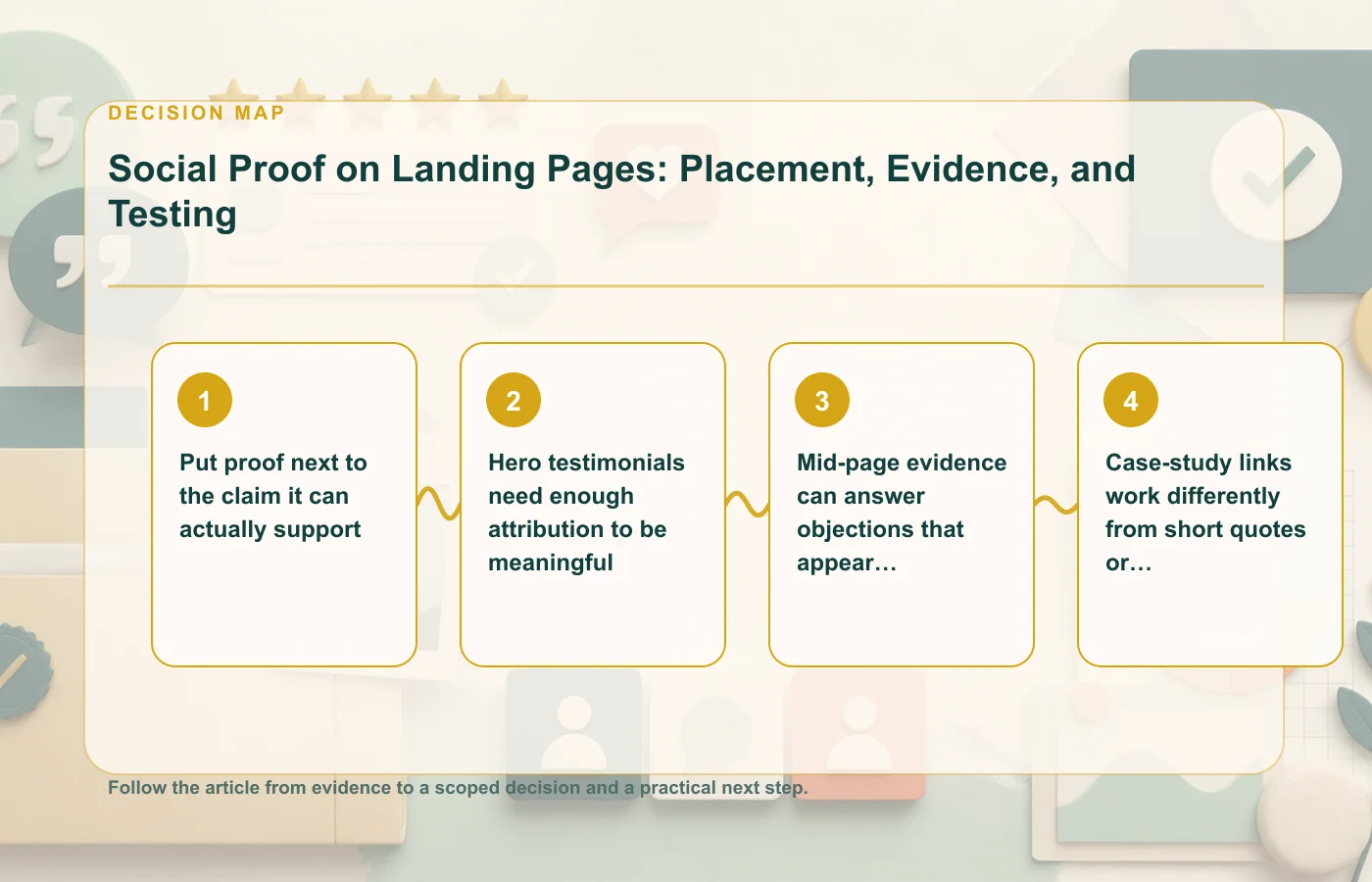
Put proof next to the claim it can actually support
Start with the page copy and identify the material claims. Then ask what evidence, if any, supports each one. If the page says the product simplifies a workflow, a quote about responsive customer service does not substantiate that statement. The proof may still be useful elsewhere, but proximity can make audiences read the two elements as connected.
Create a claim-to-proof map
- Claim: the statement the page asks the visitor to believe.
- Proof: the customer, case-study, rating, UGC, or other evidence available.
- Scope: what that evidence actually says or demonstrates.
- Placement: the section where the evidence is relevant.
- Review trigger: what change would make the proof stale or misleading.
If there is no proof for a strong claim, do not force an unrelated testimonial into the space. Narrow the claim, provide another type of evidence, or leave the section without social proof.
When the page also uses structured review data, the review schema markup guide covers that distinct technical layer.
Hero testimonials need enough attribution to be meaningful
The hero has very little room, so proof is often reduced to one sentence. That compression makes attribution more important, not less. A quote with no context may look decorative rather than credible, and a company-controlled statement can be mistaken for independent customer opinion if the source is unclear.
Keep the minimum useful context
Use the level of attribution the permission supports and the audience needs to interpret the quote. Preserve the original statement and approval record. If the testimonial has been shortened, make sure the edit does not remove a qualifier that changes the meaning.
Do not attach a large metric to a customer quote unless the source supports both. Likewise, do not combine a customer's qualitative praise with a company-authored quantitative headline in a way that implies the customer verified the number.
For customer-created visual material, the UGC formats and placement guide provides the deeper permission and disclosure framework.
Mid-page evidence can answer objections that appear after the value proposition
Visitors who continue past the hero often have a more specific question. They may want to know about implementation, fit, support, risk, or what happened for a customer in a similar situation. Mid-page proof can be stronger than repeating the same hero testimonial because it answers the objection at the moment it appears.
Use evidence modules as objection handlers
| Objection | Potential evidence |
|---|---|
| "Will this fit my use case?" | Relevant case-study context or customer example |
| "Is implementation difficult?" | Customer quote about process with enough context |
| "Can I trust this result?" | Methodology note or case-study link |
| "What do customers actually say?" | Attributed testimonials or reviews with clear source |
Do not overgeneralize from a single customer. A case study can show what happened in one context; it does not automatically establish what every visitor should expect.
The trust signals library can help when the objection concerns transaction or company credibility rather than customer evidence.
Case-study links work differently from short quotes or logo rows
Different proof formats carry different amounts of information. A logo can show a relationship only when its use is accurate and permitted. A short quote can communicate one customer observation. A case-study link can give the reader context, implementation, methodology, and limitations. Do not treat them as interchangeable blocks whose only purpose is to make the page feel trustworthy.
Choose the format by the depth of the claim
A simple qualitative statement may need only an attributed quote. A performance claim may need a full case study or methodology. A list of customer logos can help with recognition but should not be styled to imply that every customer endorses every adjacent statement.
- Use short proof for narrow, well-supported claims.
- Use deeper proof when the claim requires context.
- Do not let logo rows substitute for evidence of results.
- Keep the destination of case-study links current and accessible.
Test placement without confusing proof with other page changes
A landing-page experiment is most useful when it isolates the question being tested. If one variant moves a testimonial while also changing the offer, CTA, headline, and visual design, a conversion difference cannot fairly be attributed to proof placement.
Hold the evidence constant when testing presentation
For a placement test, use the same proof, attribution, disclosure, and surrounding claim. Change only the location or presentation element you want to evaluate. If the experiment changes the quote or rating sample, document that it is now testing evidence content as well as placement.
| Test | Hold constant | Change |
|---|---|---|
| Hero vs. mid-page testimonial | Same quote and attribution | Placement |
| Inline vs. card case-study link | Same destination and claim | Presentation |
| Proof near CTA | Same CTA offer and proof asset | Proximity |
Keep the test record beside the source record. That prevents a "winning" variant from being reused later after its permission or claim context has changed.
Maintain proof as an evidence inventory
Landing pages evolve quickly. Quotes are copied, logos are moved, product claims change, and an old case study can remain attached to a new value proposition. Create a compact inventory so each live proof element has an owner and source.
Minimum fields for each proof element
- Live page and section.
- Original source.
- Permission or approval status.
- Any material-connection disclosure.
- Claim the proof is intended to support.
- Review trigger and owner.
When the adjacent claim changes, recheck the proof even if the testimonial itself has not changed. Relevance is part of accuracy.
Review the full page for implied connections
Proof can become misleading even when the individual quote is accurate. Layout, headings, proximity, and visual hierarchy can cause readers to connect one customer statement with a different company claim. Before publishing, read the page as a sequence rather than reviewing each module in isolation.
For every proof element, ask what statement appears immediately before and after it. If a customer quote about ease of onboarding sits beneath a headline about revenue impact, the page may imply that the customer supports the revenue claim even if the quote never mentions it. Move the proof, narrow the headline, or add the evidence that actually supports the stronger statement.
Give high-impact proof a stronger source check
Hero testimonials, headline metrics, prominent ratings, and customer-logo strips can influence the overall interpretation of the page. These elements deserve a clear publication record because they are likely to be copied into future campaigns.
| Prominent element | Source check |
|---|---|
| Hero quote | Original statement, edit history, permission, attribution |
| Headline metric | Definition, baseline, period, source, methodology |
| Rating | Source, scope, inclusion logic, currentness |
| Customer logo | Approved use and relationship context |
When a prominent element is reused on another landing page, do not copy only the visible asset. Copy the evidence record and recheck the new adjacent claim. That is what keeps a credible testimonial from gradually becoming support for claims the customer never made. A periodic page review should also catch broken case-study links, expired permissions, outdated attribution, and proof that no longer matches a revised product or offer. Treat those maintenance checks as part of landing-page quality, not as optional cleanup performed only after problems actually appear publicly.
FAQ: social proof on landing pages
Should social proof always be above the fold?
No. Put proof where it answers the reader's question and supports the adjacent claim. Mid-page evidence can be more useful when it addresses a later objection.
Is a customer logo enough proof?
A logo shows much less than a case study or attributed quote and should not imply a result the customer did not substantiate.
How should I A/B test testimonials?
If the goal is placement, keep the underlying quote, attribution, disclosure, and offer constant. Otherwise the test mixes several variables and the result is harder to interpret.
How this page was prepared
Reviewed by Social Proofs Standards Editor. Claims, terminology, and time-sensitive details were checked against the sources listed below and the page was last updated September 7, 2026.
AI-assisted tools supported research organization or drafting; editorial review remained responsible for source selection and the published conclusions.
Sources and verification
Primary and authoritative references used to verify this article: