
Social Proof Examples: 18 Patterns and Where to Place Them
A practical library of reviews, activity signals, customer evidence, and assurance patterns organized by the question a visitor needs answered.
Social proof is evidence that other people, customers, experts, or institutions have made and can support the choice a visitor is considering. A logo wall, five-star score, recent-sale popup, and detailed case study are not interchangeable. Each answers a different question and carries a different burden of proof.
The useful question is not, "Which proof element should we add?" It is, "What uncertainty prevents the next decision, and what outside evidence can honestly reduce it?"
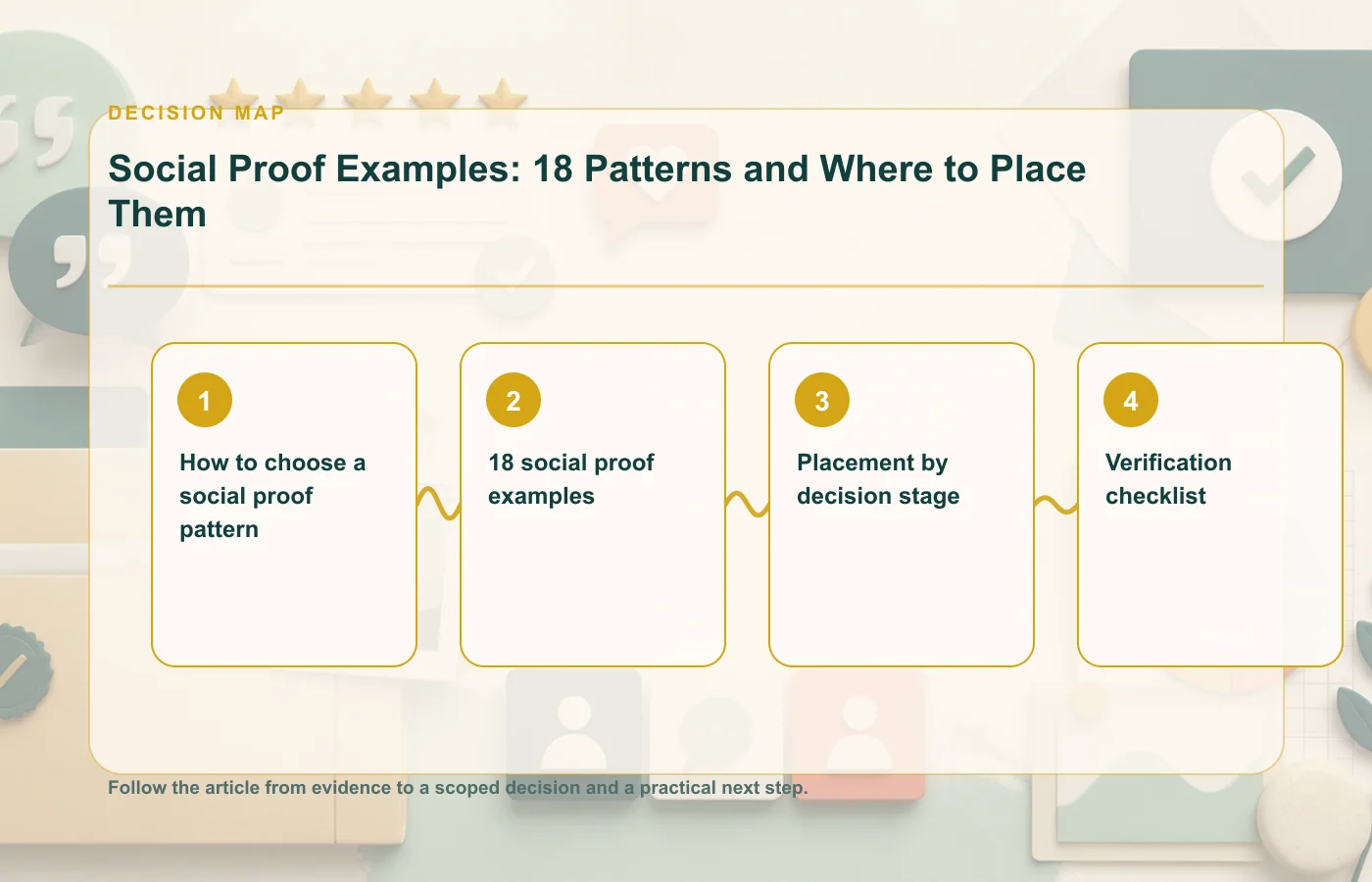
How to choose a social proof pattern
Recognition helps with unfamiliarity. A comparable story helps with fit. Reviews help with lived experience. Policies and credentials help with risk. Live activity helps only when current activity is relevant and real.
| Visitor question | Strong evidence | Weak substitute |
|---|---|---|
| Does anyone like me use this? | Segmented testimonial, relevant customer story | Unlabeled logo wall |
| Does it work? | Method, baseline, result, time frame | "Amazing product" quote |
| Is the business legitimate? | Identity, address, policies, verifiable credentials | Generic shield icon |
| Is this active now? | Timestamped, privacy-safe activity from a defined window | Randomized live counter |
18 social proof examples
Specific customer quote
Name the customer's situation, action, and result. Add a role, company, date, or source that makes the statement checkable.
Place near the claim it supports.Video testimonial
Use a transcript, captions, speaker context, and an edited-length note. Video is not proof by itself; specificity still matters.
Place on high-consideration pages.Ratings distribution
Show the average, count, scale, date range, and distribution rather than a star score floating without context.
Place beside product selection.Third-party review excerpt
Quote accurately, identify the platform, link to the source when possible, and disclose how reviews were selected.
Place near comparison or pricing.Customer story card
Summarize audience, problem, intervention, and outcome, then link to the full evidence file.
Place by use case or industry.Full case study
Preserve the baseline, time frame, dependencies, method, result, and limitations so readers can judge transferability.
Place in evaluation journeys.Customer logo with context
Explain the relationship: customer, partner, integration, investor, or publication. Permission and meaning matter.
Place early when the brand is unfamiliar.Customer or usage count
Define what is counted, the period, and the update cadence. "Users" should not quietly mean free accounts created since launch.
Place near an adoption claim.Recent activity notification
Display a real event with a meaningful time window and privacy-safe detail. Let the visitor dismiss it.
Use sparingly near the relevant action.Most-chosen option
Base the label on a defined cohort and period. Do not manufacture a "popular" badge to steer buyers.
Place inside a genuine comparison.Active member signal
Show meaningful participation such as answered questions or events, not a dormant lifetime signup count.
Place near community benefits.User-generated example
Show what a real customer made, with permission, source attribution, and enough context to understand the inputs.
Place near capability claims.Expert endorsement
State the expert's relevant qualification, actual evaluation, and any commercial relationship.
Place beside technical claims.Editorial mention
Link to the original coverage and quote narrowly. A press logo must not imply an award or endorsement that did not occur.
Place in an evidence or press area.Certification
Name the issuing body, scope, validity period, and verification route. A badge without scope is decoration.
Place where the standard reduces risk.Support performance
Define the channel, hours, response metric, sample period, and exclusions. Use operational data, not aspiration.
Place near plans or onboarding.Verified milestone
Document the measurement source and what changed. Separate correlation, customer report, and independently checked result.
Place inside a case study.Guarantee with readable terms
Put the actual duration, exclusions, process, and response expectations next to the promise.
Place at commitment points.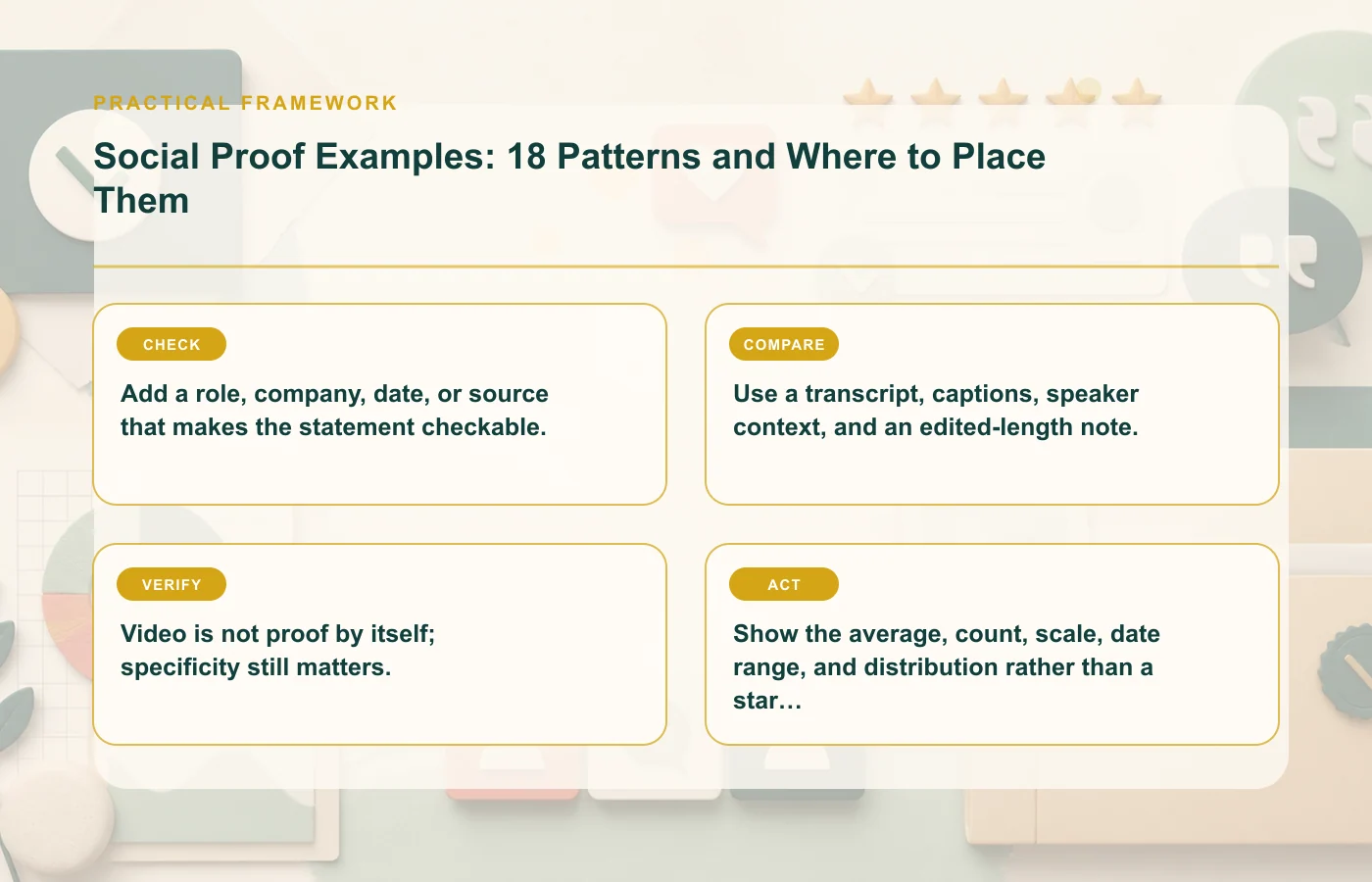
Placement by decision stage
- Discovery: establish that the organization and category are real with recognizable use cases, a restrained customer count, or accurately labeled logos.
- Evaluation: answer fit and outcome questions with segmented testimonials, review detail, comparison evidence, and customer stories.
- Commitment: reduce practical risk with policies, support expectations, security scope, guarantees, and relevant recent activity.
- After purchase: invite feedback after a meaningful interaction and explain how it may be used.
A dedicated proof library can support discovery, but the strongest evidence should also appear beside the claim or decision it supports. Do not make a visitor leave pricing to discover whether refunds exist, or leave a feature page to find the one relevant customer story.
Verification checklist
- The person, event, score, credential, or result exists.
- The wording accurately reflects the source and has not been edited into a different claim.
- Material relationships and incentives are disclosed where readers will notice them.
- Exceptional outcomes include enough context to avoid implying that they are typical.
- Counts and "live" signals define the population and time window.
- Personal data is minimized and used with an appropriate legal basis.
- The element remains readable, dismissible, and usable with a keyboard.
- The team can identify an owner and refresh or remove stale evidence.
Choose the highest-friction page, document the visitor's likely doubt, add the smallest credible evidence pattern, and measure the decision outcome. More proof is not automatically more trust.
Sources and standards
- FTC: Consumer Reviews and Testimonials Rule Q&A
- Google Search Central: Review snippet structured data
How this page was prepared
Reviewed by Social Proofs Standards Editor. Claims, terminology, and time-sensitive details were checked against the sources listed below and the page was last updated August 6, 2026.
AI-assisted tools supported research organization or drafting; editorial review remained responsible for source selection and the published conclusions.
Sources and verification
Primary and authoritative references used to verify this article: