
Incentivized Reviews: Disclosure and Editorial Safeguards
Incentivized reviews need more than neutral wording. Keep the benefit independent of sentiment, disclose material connections, avoid review gating, and check platform rules.
Incentivized reviews are not automatically the same thing as positive reviews. The key boundary in the source material is sentiment: FTC guidance says an incentive for a consumer review cannot be expressly or implicitly conditioned on the review expressing a particular positive or negative sentiment. A compliant workflow therefore needs neutral eligibility and wording, clear material-connection disclosure where required, and a separate check of the destination platform's rules.
The incentive itself is only one part of the campaign. The team should preserve the exact offer, who was eligible, the request wording, the disclosure language, and the platform policy used when the campaign was approved. That record matters because a sentiment-neutral offer can still become misleading if disclosure disappears, negative reviewers are suppressed, or the platform prohibits the practice more broadly.
| Campaign decision | Evidence to retain | Editorial safeguard |
|---|---|---|
| Incentive offer | Exact benefit and terms | Do not condition it on positive sentiment |
| Eligibility | Audience rule and exclusions | Do not cherry-pick expected promoters |
| Request wording | Final message version | Ask for honest feedback without steering rating |
| Disclosure | Approved disclosure language and placement | Keep material connections clear in the publication context |
| Destination policy | Platform rule and review date | Follow stricter platform requirements where they apply |
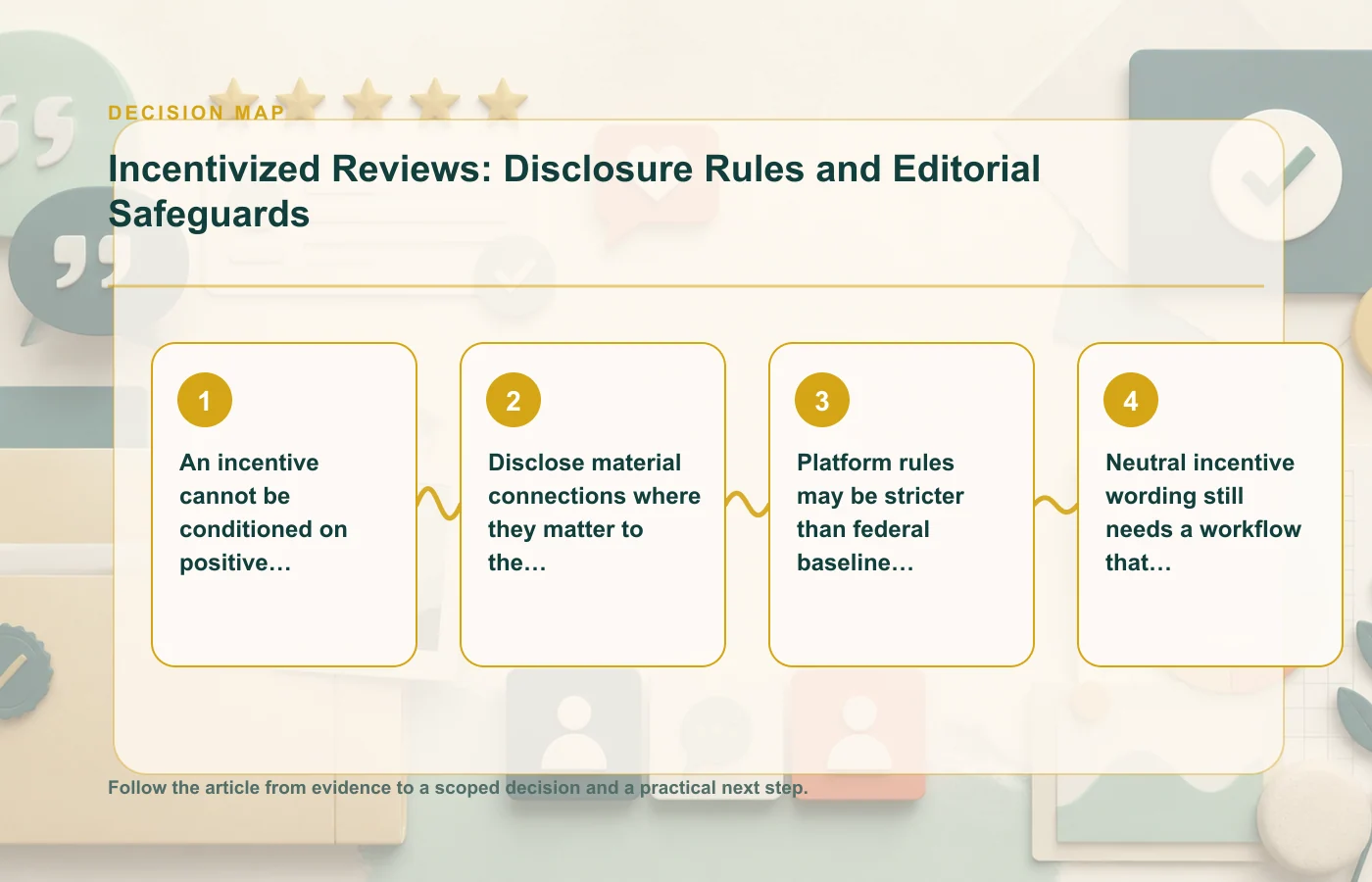
An incentive cannot be conditioned on positive sentiment
The most important design test is whether the customer receives the same promised benefit regardless of whether the review is positive, neutral, or negative. If the wording says or implies that a reward depends on praise, the campaign crosses the sentiment boundary described in FTC guidance.
Check the whole offer, not one sentence
Conditioning can be explicit or implied. Review the email, landing page, button text, staff script, terms, and follow-up messages together. A neutral headline does not fix fine print that limits the incentive to "good reviews," and a neutral legal note does not fix a salesperson verbally asking for five stars.
- Describe the incentive accurately.
- Make eligibility independent of the expected rating.
- Do not withdraw the benefit after a negative review.
- Do not tell staff to coach customers toward a positive sentiment.
- Keep the exact campaign wording in the approval record.
The trust signals resources are a better next step when the marketing question is broader credibility rather than incentivized review collection itself.
Disclose material connections where they matter to the audience
Even when an incentive is sentiment-neutral, it can affect how an audience interprets the review. The source material therefore keeps disclosure as a separate requirement. The publication should not make incentivized feedback look like unsolicited independent opinion when the material connection is relevant to the audience's understanding.
Make disclosure travel with the review context
A disclosure that was clear on the original collection page may disappear when the review is copied into a product page, landing page, ad, social post, or email. Treat every reuse as a publication check: can the audience still understand the material connection in this new context?
| Reuse context | Question to recheck |
|---|---|
| Review platform | Does the platform label or require disclosure for the incentive? |
| Website testimonial | Is the material connection clear near the endorsement? |
| Paid advertising | Does the new ad context preserve the necessary disclosure? |
| Social content | Is the relationship apparent in the post as published? |
Do not assume the signed campaign terms are enough. The customer's consent to participate and the audience's need to understand the connection are different questions.
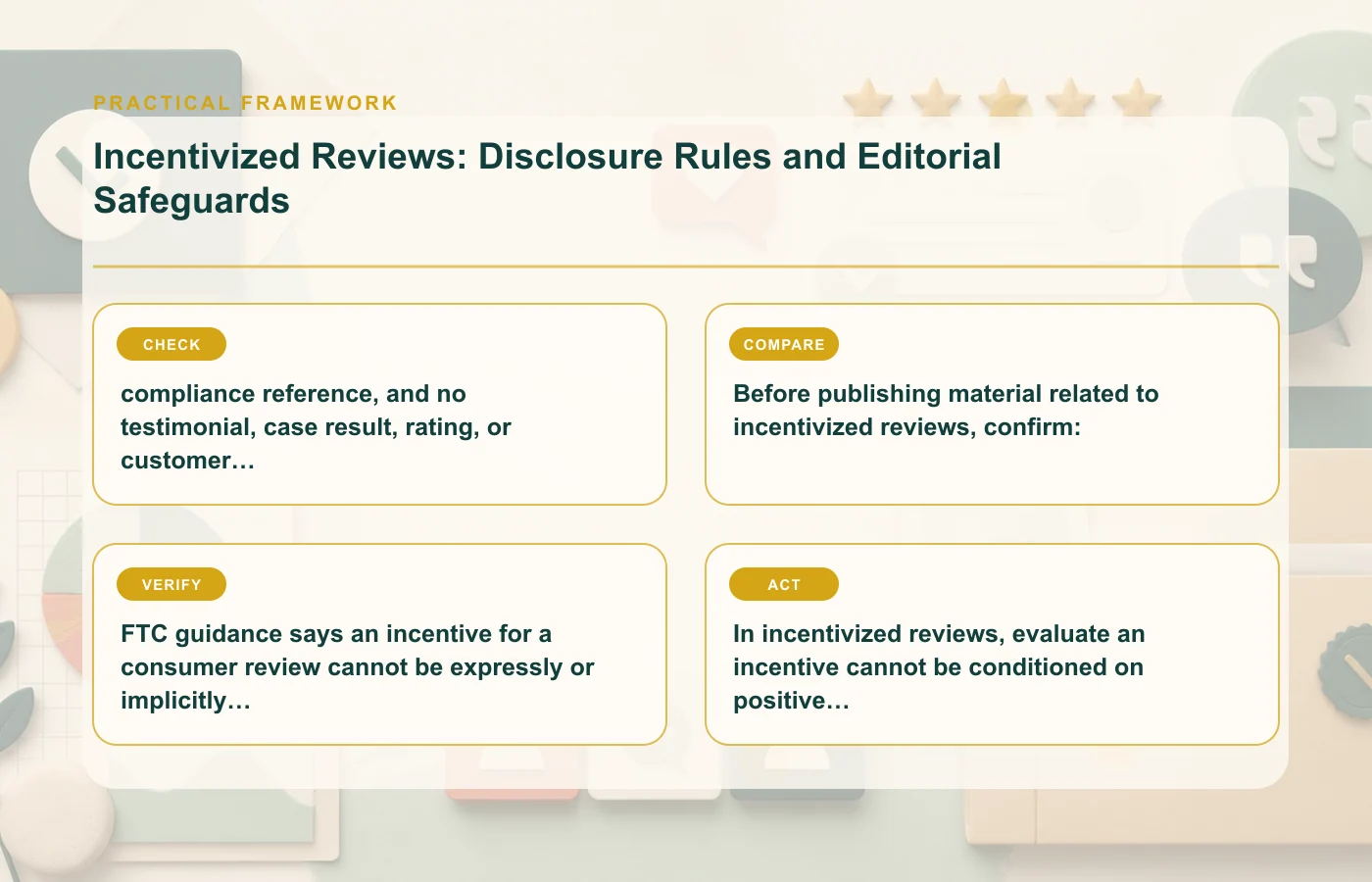
Platform rules may be stricter than federal baseline guidance
A campaign can satisfy the general sentiment-neutral principle and still be inappropriate for a particular destination. Platforms can impose stricter rules on incentivized reviews, eligibility, disclosure, or review collection. That is why the approval record should identify the destination policy reviewed, not simply say "FTC compliant."
Make destination policy part of launch QA
- Identify every platform where the review may be requested or published.
- Check the current policy before launch or major reuse.
- Record the policy version or review date used for approval.
- Do not assume a campaign approved for one platform can be copied to another.
- Assign an owner for rechecking policy changes.
If the destination no longer permits the planned incentive or requires different disclosure, change the campaign rather than relying on the older approval. The platform rule is part of the operating environment.
For placement-specific issues after customer evidence is collected, the social-proof landing-page guide covers claim relevance, attribution, and testing.
Neutral incentive wording still needs a workflow that avoids review suppression
A sentence such as "receive the benefit for an honest review" does not make the program fair if the audience selection quietly excludes likely critics. Incentive design and review gating are separate controls. Use broad, consistently defined eligibility rules based on a real customer event rather than a predicted satisfaction score.
Separate operational exclusions from sentiment selection
A customer may be suppressed because the experience is not complete, a material support issue is unresolved, the person opted out, or a duplicate request would be inappropriate. Those reasons can be operationally defensible. Excluding someone because a survey score predicts a negative public review is a different decision.
| Exclusion reason | How to treat it |
|---|---|
| Experience not yet reviewable | Delay until the qualifying event |
| Open material support issue | Suppress or pause under a documented rule |
| Customer opt-out | Respect the communication preference |
| Duplicate customer/experience | Deduplicate according to the defined unit |
| Expected negative sentiment | Do not use as a public-review eligibility filter |
A neutral offer should be sent through a neutral path. If the workflow changes, re-audit both the audience logic and the request copy.
The ecommerce social proof guide is relevant when incentivized or customer-created content is later reused on product, cart, or checkout pages.
Employee and insider reviews require particular care
Employees, owners, agents, and other insiders have a relationship with the business that can materially affect how an audience interprets their endorsement. The source material flags these reviews for particular care. A relationship should not be hidden so the content appears to come from an independent customer.
Identify the relationship before publication
Ask whether the reviewer has an employment, ownership, family, agency, contractor, creator, or other connection relevant to the audience's interpretation. Then check the applicable FTC guidance and the destination platform's rules. Some platforms may prohibit or restrict insider reviews beyond the general disclosure baseline.
Do not solve an insider-review problem with a tiny disclosure if the destination platform does not permit the review. Platform policy should be checked first. If the content is used in another endorsement format rather than a public customer-review system, keep the relationship clear and the claim no broader than the person's actual experience.
Build an auditable incentive campaign record
Incentivized-review programs can change quickly. A marketer updates the offer, another team changes the audience, the platform revises its policy, and an old review is later reused in advertising. Keep one record that connects those decisions instead of storing them in separate inboxes.
Minimum campaign record
- Campaign purpose and destination.
- Exact incentive and eligibility terms.
- Audience-selection and suppression rules.
- Request copy and follow-up versions.
- Disclosure language and placement.
- Relevant FTC and platform-policy review date.
- Owner and conditions that trigger re-review.
When a campaign is modified, compare the new version against the approved record. A small wording change can matter if it introduces sentiment steering. A new audience rule can matter even if the email is unchanged. A new platform can make the original policy review irrelevant.
Audit outcomes without rewarding positive sentiment
Program reporting can track eligible customers reached, duplicate suppression, opt-outs, policy exceptions, and workflow errors without making "percentage of positive reviews" the operating target. If teams are rewarded primarily for producing high ratings, the incentive structure can encourage review gating or coaching even when the written policy says otherwise.
Use audit findings to improve the process. If staff repeatedly explain the offer inconsistently, revise training. If disclosures disappear during reuse, improve the asset record. If a platform change invalidates an active campaign, stop it and reapprove rather than relying on historical practice.
Recheck reused reviews when the original campaign context disappears
A review collected through an incentive campaign may later be copied into a testimonial carousel, case study, product page, or ad. The new editor may see only the review text and miss the original material connection. Preserve campaign provenance at the individual asset level so reused content does not lose the disclosure context that mattered when it was collected.
Before reuse, confirm which incentive applied, whether the review was sentiment-neutral, what disclosure appeared originally, and what the new audience will see. If the new format cannot present the connection clearly enough, do not solve the problem by deleting the provenance record. Change the presentation or choose different evidence.
This is also a reason to avoid exporting reviews into untracked spreadsheets or design files without source identifiers. The visible quote should remain connected to the collection campaign, reviewer record, and publication decisions throughout its lifecycle.
FAQ: incentivized reviews
Can I give a customer something for leaving a review?
The source material says an incentive cannot be expressly or implicitly conditioned on the review expressing a particular sentiment. The material connection may need disclosure, and the destination platform may impose stricter rules.
Does "honest review" wording make any incentive acceptable?
No. The audience selection, benefit terms, disclosure, and platform rules still matter. Neutral words do not fix review gating or a prohibited destination practice.
Do employee reviews need disclosure?
Employee and insider relationships require particular care because the connection can affect how the audience interprets the endorsement. Check both FTC guidance and the destination platform's rules.
How this page was prepared
Reviewed by Social Proofs Standards Editor. Claims, terminology, and time-sensitive details were checked against the sources listed below and the page was last updated September 14, 2026.
AI-assisted tools supported research organization or drafting; editorial review remained responsible for source selection and the published conclusions.
Sources and verification
Primary and authoritative references used to verify this article: