
Social Proof for Ecommerce: Product, Cart, and Checkout
Place ecommerce social proof according to the buyer question at each stage. Keep reviews attributable, ratings scoped, checkout protections accurate, and UGC permissioned.
Social proof in ecommerce should reduce a specific uncertainty without pretending that marketing-controlled material is independent customer opinion. Product reviews, customer photos, Q&A, expert evidence, transaction assurances, and aggregate ratings can all be useful, but each type answers a different question and needs accurate attribution.
The location of the proof matters because the buyer's questions change across the journey. A product page may need evidence about fit, use, or product-specific experience. The cart should reinforce the purchase decision without introducing misleading urgency or disguised advertising. Checkout trust signals should explain real protections or policies rather than rely on vague badges that imply certifications the merchant does not have.
| Page stage | Useful proof | Main guardrail |
|---|---|---|
| Product page | Reviews, UGC, Q&A, expert or product-specific evidence | Keep the proof tied to the exact product and claim |
| Cart | Relevant reassurance, review context, policy reminders | Do not disguise brand-controlled messaging as independent opinion |
| Checkout | Payment, return, shipping, or security information that is actually true | Do not imply certifications or protections that do not exist |
| Ratings summary | Aggregate customer feedback | State the source and scope clearly |
| Visual UGC | Customer photos or demonstrations | Preserve permission, attribution, and disclosure where needed |
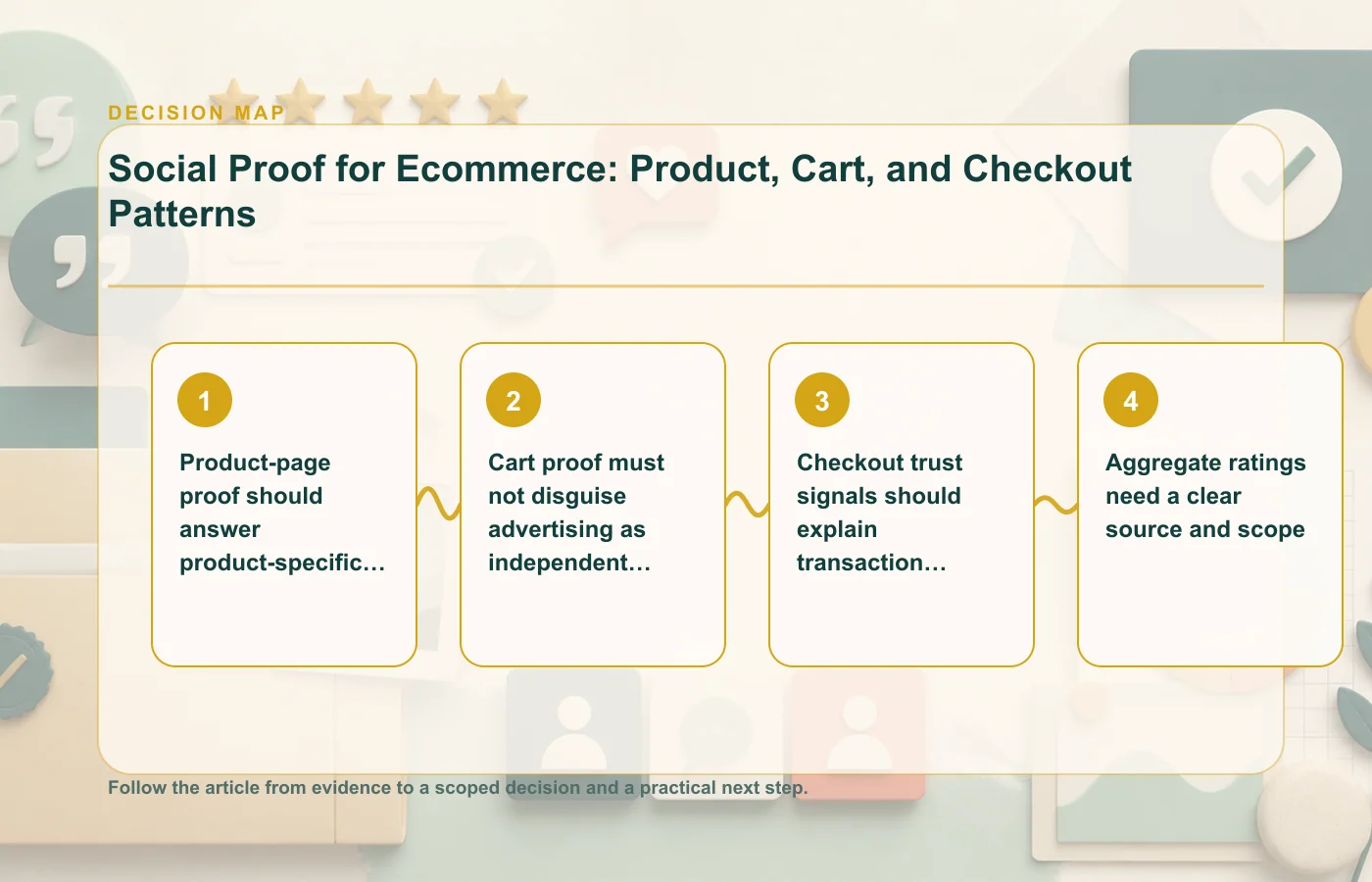
Product-page proof should answer product-specific uncertainty
The product page is where social proof can be most concrete. A shopper may want to know how an item looks in real settings, whether instructions are understandable, what other customers found useful, or how a specific feature behaves. Choose proof that addresses the question rather than adding a generic testimonial block simply because "social proof converts."
Map evidence to the decision
- Reviews can describe customer experience, but the source and moderation process should remain clear.
- Customer photos can provide visual context when permission allows reuse.
- Q&A can answer narrow product questions where the answer remains accurate.
- Expert evidence should be attributed accurately and should not be presented as a customer review.
- Transaction assurances should describe real policies rather than product performance.
Do not place a review about one variant next to another variant if the difference changes the meaning. Likewise, do not use a general store testimonial to substantiate a product-specific performance claim.
When structured review data is part of the publishing plan, the review schema markup guide covers that separate implementation question.
Cart proof must not disguise advertising as independent customer opinion
The cart is a brand-controlled environment, so the buyer should be able to tell what is a customer statement and what is merchant messaging. FTC rules prohibit fake or false reviews and certain company-controlled review representations that appear independent. That makes provenance and labeling especially important when proof is condensed into small cards, badges, or snippets.
Keep attribution visible enough to interpret the claim
If a testimonial is shortened for the cart, compare the edit with the original. Do not remove a qualification that changes meaning. If a message is written by the company, present it as company information rather than styling it to resemble a third-party review.
The cart is also a poor place for unrelated proof. A generic quote that does not address the product, seller, or transaction can add clutter without reducing uncertainty. Use a smaller number of relevant elements and keep the purchase path clear.
Checkout trust signals should explain transaction protections accurately
At checkout, social proof often gives way to transaction trust. Customers are deciding whether the merchant will handle payment, delivery, returns, and personal information as expected. The most credible trust signals describe a real policy or protection in plain language.
Explain the protection, not just the badge
| Signal | Useful explanation | Risky presentation |
|---|---|---|
| Returns | Link to the actual return policy and key conditions | "Risk-free" when exclusions materially apply |
| Shipping | State the applicable delivery or shipping terms | Vague certainty unsupported by the policy |
| Payment/security | Describe real payment or security handling accurately | Unofficial badges that imply certification |
| Support | Show the actual support route or service commitment | Guarantees not reflected in operations |
Do not add visual seals simply because they look trustworthy. If a badge represents a certification, partner status, or other third-party assurance, verify that the merchant actually holds it and that the presentation follows the provider's terms.
Aggregate ratings need a clear source and scope
An average rating can look precise while leaving basic questions unanswered: ratings for what product, over what set of reviews, from which source, and under which moderation rules? Keep the scope clear enough that a shopper does not mistake a store-wide rating for product-specific feedback or a selected sample for the full review base.
Keep aggregation definitions stable
If ratings are combined across variants, channels, or periods, document the method. If the display changes, keep the source record and logic so the team can explain what the number represents. Do not silently remove unfavorable reviews to improve the aggregate.
- Identify whether the rating is product, seller, or service level.
- Keep the source attributable.
- Use a consistent inclusion rule.
- Separate verified platform data from company-authored claims.
The broader social proof examples guide can help when comparing rating modules with other evidence patterns.
Visual UGC can help with fit or use, but permission remains necessary
Customer photos and videos can answer questions that polished brand imagery does not, especially around fit, setup, scale, or real-world use. Their usefulness does not remove the need for rights and permission appropriate to the asset and channel. If an incentive or creator relationship exists, disclosure may also be relevant.
Keep the source attached during reuse
Store the original asset, permission record, edit history, attribution, and any material-connection information together. When the image is cropped, captioned, or moved into an ad, recheck whether the new presentation changes what the audience would infer.
Do not turn a customer image into a performance claim the customer did not make. A photo can show appearance or use; it does not automatically prove durability, effectiveness, or a general outcome.
The UGC formats and placement guide provides the deeper rights, disclosure, and evidence framework.
Build a page-by-page proof inventory
Before adding new widgets, inventory what proof already exists and what question each element is supposed to answer. This prevents duplicate modules and makes it easier to spot claims that have lost their source.
Audit from product page through checkout
- List every review, rating, quote, badge, policy promise, and UGC asset.
- Identify the source and permission or policy record behind it.
- Write the buyer question the element is meant to resolve.
- Remove or revise elements that imply more than the evidence supports.
- Assign an owner and review trigger for claims that can become outdated.
A proof inventory also makes testing cleaner. If a module is moved or redesigned, the team can test presentation without accidentally changing the underlying claim, source, or disclosure at the same time.
Moderate for relevance and policy, not for praise
An ecommerce review program needs moderation, but moderation should not become a hidden way to manufacture a more positive picture. Define reasons for rejection or removal in advance: spam, prohibited content, privacy issues, irrelevance, or other documented platform or site-policy grounds. A negative opinion about a real experience is different from content that violates the moderation standard.
Keep a moderation log detailed enough to explain why content was excluded. That protects both customers and the business when someone later asks why a review, photo, or Q&A answer disappeared. It also gives the ecommerce team a way to audit whether the policy is being applied consistently across positive and negative material.
Test placement without changing the evidence
Social-proof modules are often A/B tested, but a placement test should not quietly become a claim test. If one variant changes the quote, rating sample, attribution, or disclosure while also changing position, the result cannot tell you whether placement caused the difference. Keep the underlying evidence constant when the goal is to test location or design.
| Experiment | Hold constant | Change |
|---|---|---|
| Review placement | Same review set, scope, and attribution | Location on the product page |
| UGC presentation | Same permissioned asset and caption claim | Card, carousel, or inline placement |
| Trust information | Same policy and factual wording | Visual hierarchy or proximity to checkout action |
| Case-study link | Same destination and customer evidence | Anchor, placement, or supporting layout |
When an experiment does change the evidence or claim, review it as new content. A stronger quote, different rating scope, new badge, or revised policy statement needs its own provenance and accuracy check before it enters a test.
Assign review triggers to proof that can go stale
Some ecommerce proof changes with the product, seller, policy, or customer relationship. A customer photo can become misleading after a redesign. A return-policy reassurance can become wrong after the policy changes. A rating module can shift scope when products are merged or variants change. Give those assets an owner and a reason to be rechecked rather than assuming publication is permanent.
Keeping the source record close to the live module makes maintenance practical: the next editor can see what the element says, why it was approved, and what change should trigger a new review before the proof continues running across product, cart, checkout, or campaign placements.
FAQ: ecommerce social proof
Should I put testimonials in the cart?
Only when they are relevant and clearly attributable. The cart should not disguise merchant-created advertising as independent customer opinion or become cluttered with unrelated proof.
Are trust badges the same as social proof?
Not exactly. At checkout, many "trust signals" describe transaction protections or policies. They should be accurate and should not imply certifications the merchant does not hold.
Can I reuse customer photos on product pages?
Use a permission process appropriate to the asset and channel, preserve attribution and disclosure context, and do not turn the image into a broader claim than it supports.
How this page was prepared
Reviewed by Social Proofs Standards Editor. Claims, terminology, and time-sensitive details were checked against the sources listed below and the page was last updated August 31, 2026.
AI-assisted tools supported research organization or drafting; editorial review remained responsible for source selection and the published conclusions.
Sources and verification
Primary and authoritative references used to verify this article: