
Social Proof Notifications: Patterns, Ethics, and an A/B Test Plan
Design recent-activity and popularity notifications that use real events, protect privacy, remain dismissible, and can be measured without invented urgency.
Social proof notifications display recent purchases, signups, reviews, visitor counts, or another activity signal while someone browses a site. The format can answer "Is this active?" or "Do people like me choose this?" It can also look fabricated, interrupt reading, leak personal data, and create false urgency.
Start with the event and user question, not the widget. If the underlying activity is too sparse, irrelevant, or sensitive, choose a static and better documented proof pattern instead.
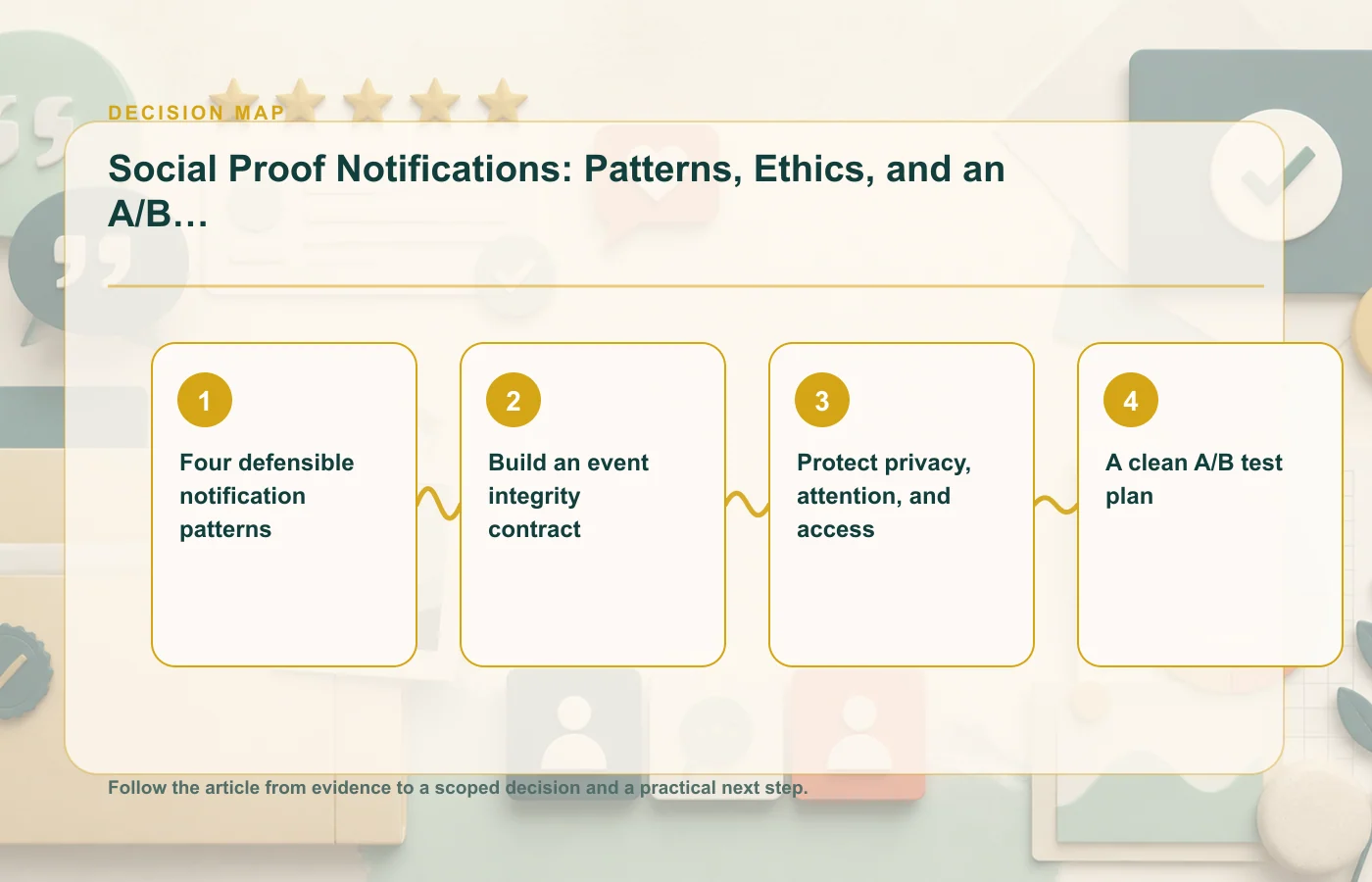
Four defensible notification patterns
Recent conversion
"A team in Canada started a trial 18 minutes ago." Use coarse location and no personal name unless explicit consent supports it.
New verified review
Show a narrow excerpt, date, score, and route to the complete review or review policy.
Relevant use case
Match a real customer example to the current page or segment without implying hidden surveillance.
Defined activity count
"37 completed checkouts in the last 24 hours" is meaningful only when the window, event, and update method are real.
Build an event integrity contract
| Field | Required definition | Failure to prevent |
|---|---|---|
| Event | The completed action and deduplication rule | Counting page views as purchases |
| Time | Event time, display delay, and expiry window | Calling an old event "recent" |
| Identity | Allowed granularity and consent record | Exposing a customer's name or location |
| Population | Which products, plans, or regions are included | Showing an irrelevant global count |
| Fallback | What appears when no valid event exists | Inventing activity to fill the queue |
Do not randomize names, locations, timestamps, counts, or spacing to imitate activity. If a demo uses fictional data, label it clearly as a demonstration and keep it out of the live buying journey.
Protect privacy, attention, and access
- Minimize identity. Product, country, or broad region may be enough; sometimes no location is needed.
- Document the purpose and legal basis for collecting and displaying event data in each relevant jurisdiction.
- Do not reveal sensitive products, health information, relationship status, or another private context.
- Provide a persistent close control with an accessible name and keyboard support.
- Keep the notification away from navigation, consent controls, form labels, and primary actions.
- Pause or stop automatically updating content when it continues beyond five seconds and is not essential.
- Respect reduced-motion preferences; a quiet appearance is usually enough.
- Cap frequency per session and remember dismissal where permitted.
A clean A/B test plan
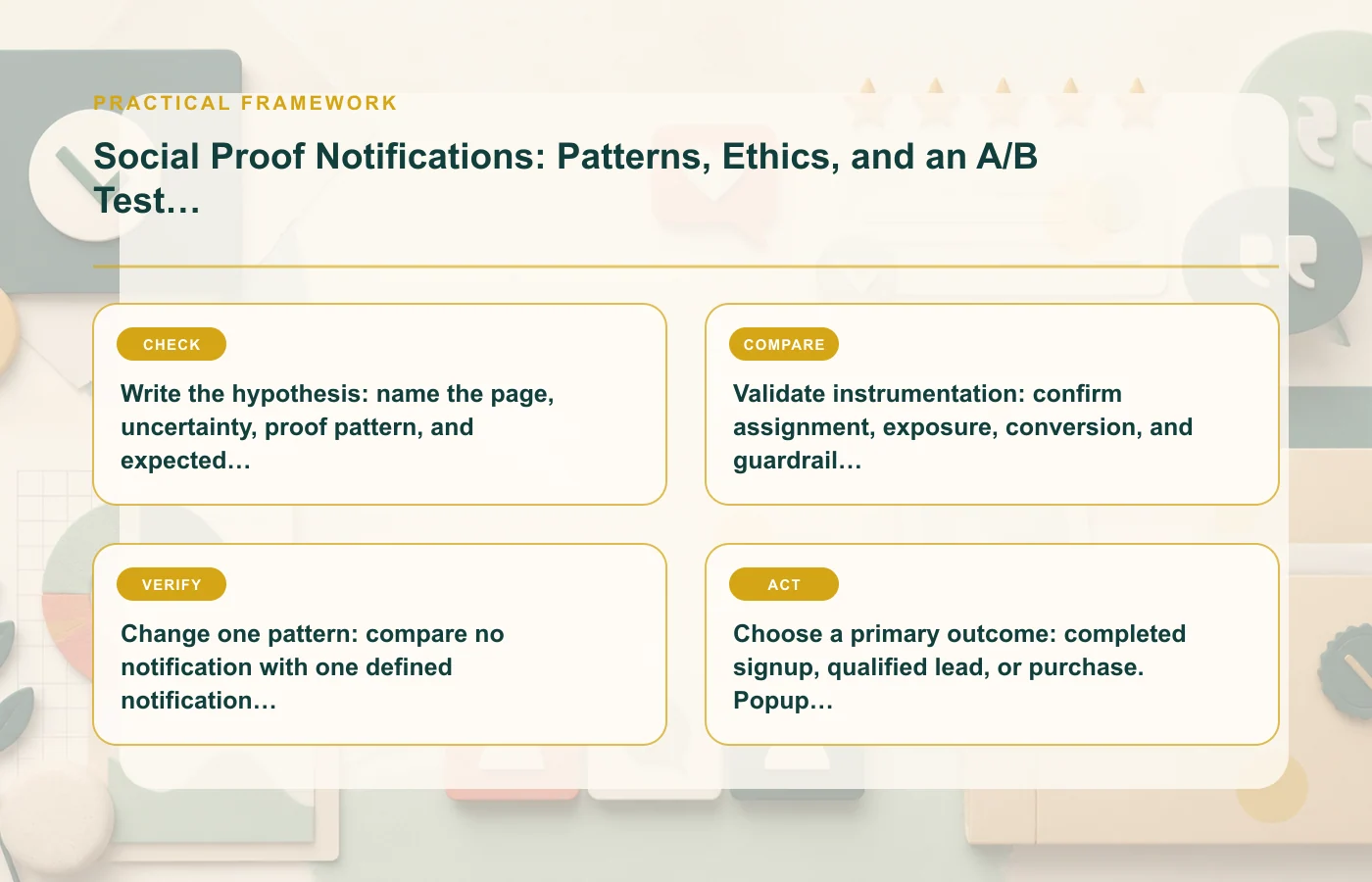
- Write the hypothesis: name the page, uncertainty, proof pattern, and expected decision behavior.
- Validate instrumentation: confirm assignment, exposure, conversion, and guardrail events before launch.
- Change one pattern: compare no notification with one defined notification system, not several simultaneous redesigns.
- Choose a primary outcome: completed signup, qualified lead, or purchase. Popup click-through is diagnostic, not the business result.
- Add guardrails: monitor form completion, errors, bounce, dismissal, support complaints, page performance, and refunds.
- Set the decision rule first: document duration, sample assumptions, segments, and what result would justify shipping or stopping.
- Review quality after conversion: a pressured signup that quickly cancels is not a win.
Notification tools can later be compared on event integrity, integrations, targeting, accessibility, privacy controls, performance, experimentation, and exportability. Commission rate should not determine the score. Until tools are tested, this site keeps commercial links out of the guide.
Sources
How this page was prepared
Reviewed by Social Proofs Standards Editor. Claims, terminology, and time-sensitive details were checked against the sources listed below and the page was last updated August 6, 2026.
AI-assisted tools supported research organization or drafting; editorial review remained responsible for source selection and the published conclusions.
Sources and verification
Primary and authoritative references used to verify this article: